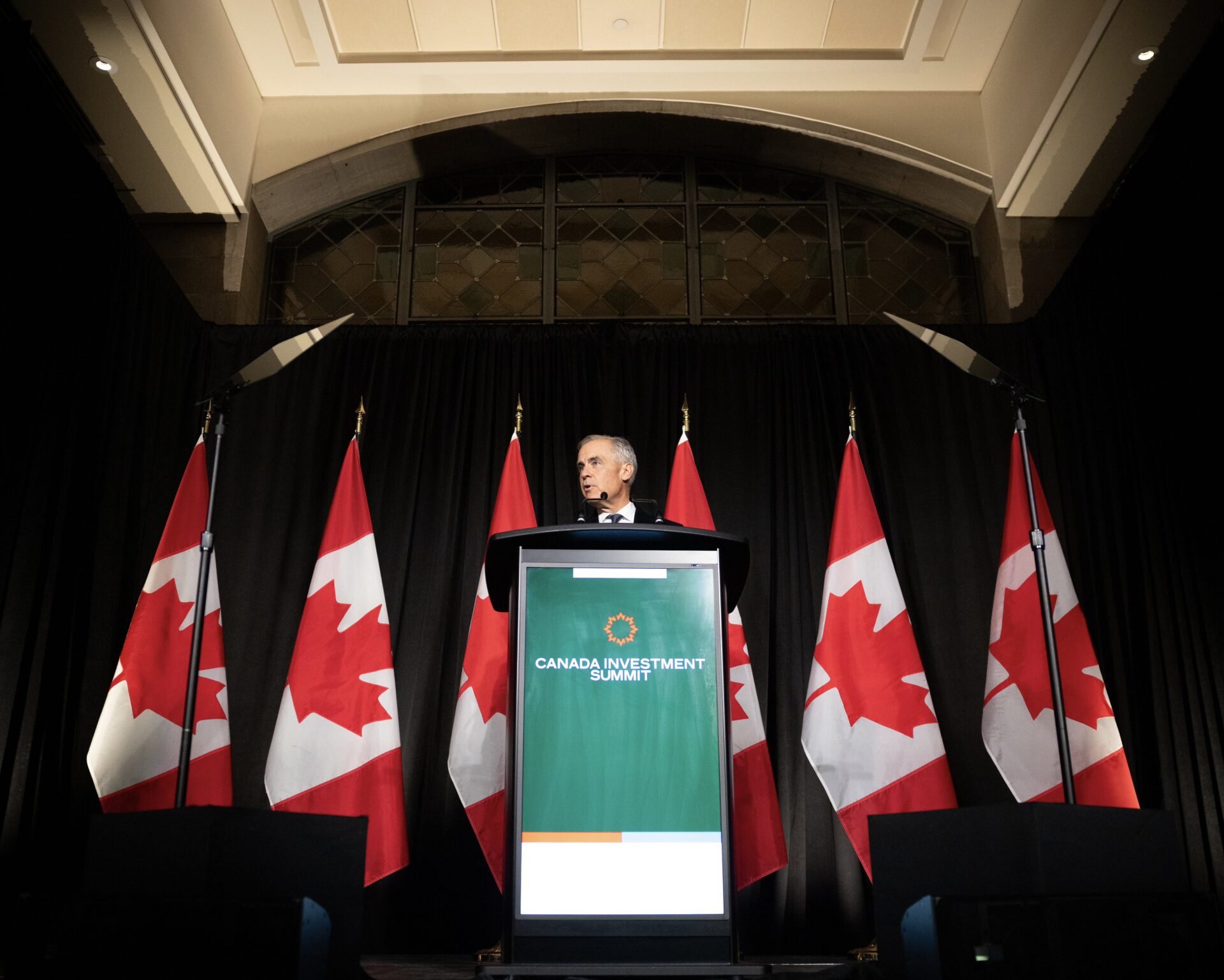

At the first Canada Investment Summit Prime Minister Mark Carney announced early $500 billion in new investment commitments to Canada, a new productivity ‘mega deduction,’ which will allow businesses to deduct the cost of a much broader range of assets right away and that the feds will seek private investment through long-term concessions to operate Canada’s four largest airports.
Hosted in partnership with the Canada Pension Plan Investment Board (CPP Investments) and the Public Sector Pension Investment Board (PSP Investments), the Summit brought together investors from nearly 30 countries, managing more than $100 trillion in assets.
“The Canada Investment Summit brought the world to Canada with a clear message: Canada is building big. Build with us,” said Carney. “We unleashed nearly $500 billion of new investment into Canadian businesses and infrastructure – and this is just the beginning. The world sees our strengths and ambitions, and we will harness this moment to generate lasting growth, opportunity, and prosperity for Canadians. Canada is boldly unleashing our enormous potential, and we are just getting started.”

The new productivity deduction, will allow businesses to deduct assets, including fibre-optic cable, mining property, oil and gas pipelines, software, research and development, computer equipment, aircraft and vehicles, patents, rail track, bridges, and roads right away. The federal government is also making immediate expensing permanent so businesses can recover these costs sooner. The new deduction means Canada’s marginal effective tax rate on new business investment will fall from roughly 13 to 6.4 per cent – the lowest of any major economy in the world and less than half the rate in the United States.
“This is one of the most significant changes to Canada’s business tax system in half a century, and a game changer for investment in this country. With the Productivity Mega Deduction, we are reinforcing Canada’s position as the most competitive country in the G7 for new business investment and setting the conditions for an investment supercycle,” said François-Philippe Champagne, Minister of Finance and National Revenue.
When it comes to airports, Carney said the federal government will retain ownership of the underlying land and assets, while also bringing in new private capital. The tens of billions of dollars of capital raised would then be reinvested into building the infrastructure that Canada needs for the next generation: regional airports, new local transportation infrastructure, and new nation-building infrastructure, including a sovereign broadband backbone that connects Canadians from coast to coast to coast.
Check out the 50 biggest projects being highlighted at the Canada Investment Summit.
Canada’s leading pension funds, insurers, and institutional investors committed nearly $100 billion in new capital to Canadian assets:
- CPP Investments and Brookfield Asset Management launched the $50 billion Maple Fund to invest in critical infrastructure and strategic industries across Canada.
- PSP Investments will increase its Canadian investments by 30 to 40%, an additional $25 billion in Canada, totalling $100 billion.
- The Ontario Teachers’ Pension Plan (OTPP) will invest an additional $10 billion in Canadian opportunities across public and private markets by the end of 2027.
- Sun Life Financial will invest $5 billion over the next five years in critical infrastructure, including digital technology, energy, and transportation.
Canada’s top banks committed nearly $325 billion in new financing for Canadian businesses and infrastructure:
- TD Bank will provide $150 billion in financing over five years across five key sectors, including energy, critical minerals and resources, defence and aerospace, digital and AI, and infrastructure.
- Scotiabank will provide over $100 billion in financing over five years to support Canadian companies and projects in key sectors that will drive forward Canada’s economic growth agenda.
- BMO will invest and mobilise $70 billion in critical Canadian sectors over 10 years, including in energy and transportation infrastructure, mining and critical minerals, AI computing, and defence and security.
- CIBC will provide $2 billion in financing to small and medium-sized defence-related and dual-use businesses in Canada. Funding will be targeted to support eligible businesses operating across a range of strategic sectors, including infrastructure, energy, cybersecurity, digital capabilities, and advanced technologies.
- RBC will invest and mobilise nearly $1.5 billion to support Canadian technology companies with high growth potential. They will provide investee companies with access to commercialisation opportunities, strategic partnerships, and expansion support that are often unavailable through traditional investors.
Featured image: (Government of Canada)