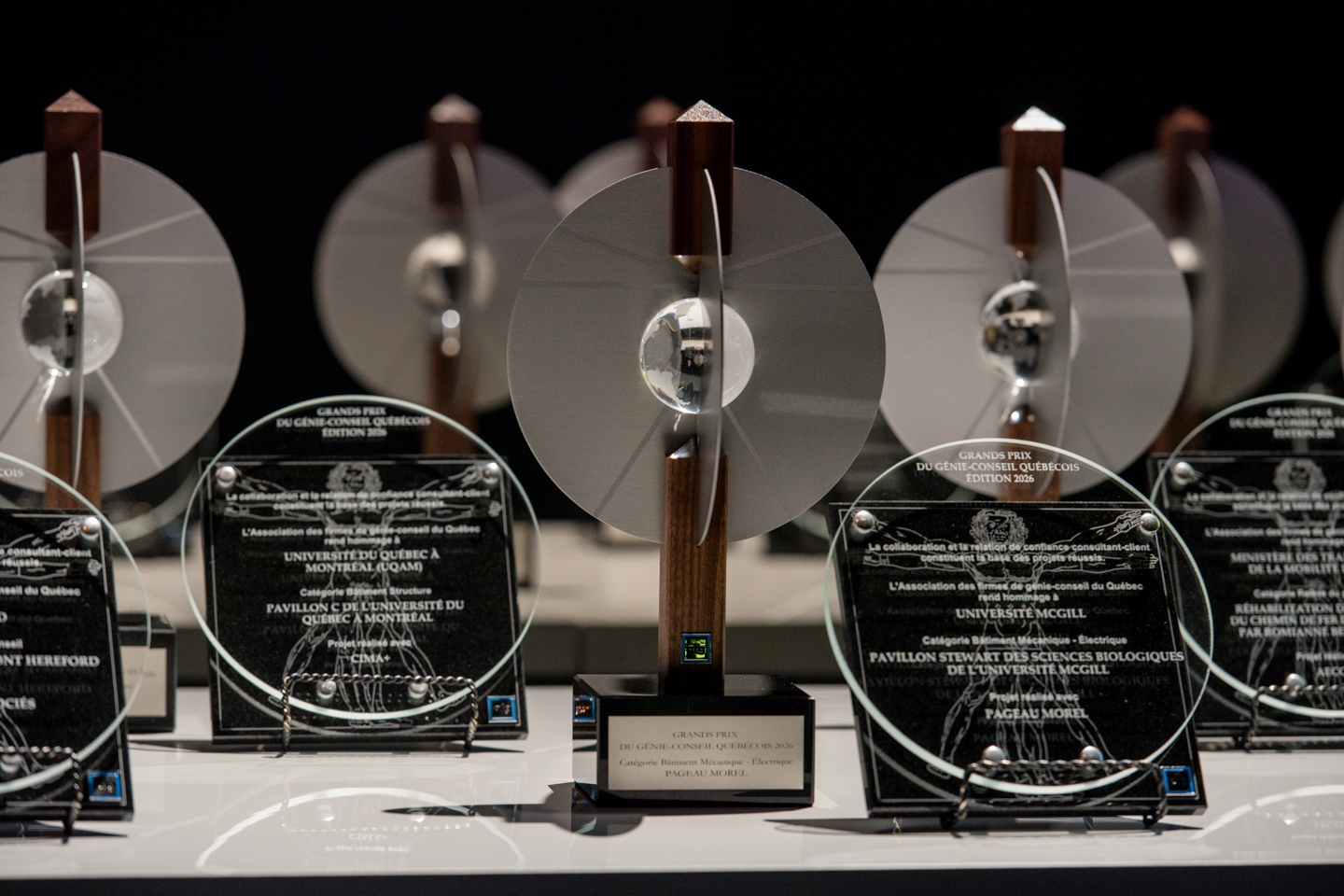

More than 450 participants gathered to attend the 24th of the Grands Prix du génie-conseil québécois 2026, where the best engineering projects recently completed were recognized among 63 competing projects and candidates, in 14 categories.
Under the theme ENGINEERING+CONSULTING: Collaborating to Rise , this prestigious awards ceremony, organized by the Association of Consulting Engineering Firms of Quebec (AFG), was hosted by Stéphane Bellavance.
The winning projects were selected by an independent jury represented by Sandra Avakian, Senior Director of Land Management for the City of Brossard. To distinguish between these exceptional achievements, each project was analyzed according to key criteria, including its innovative nature and complexity, as well as its socio-economic benefits and contribution to sustainable development.

“The award-winning projects demonstrate our industry’s capacity for innovation. In this regard, collaboration between multiple disciplines and stakeholders in the execution of increasingly complex projects is a guarantee of success,” said Bernard Bigras, president and CEO of the AFG.
“Collaborating to rise means innovating in partnership with the client. Consulting engineering firms are trusted strategic advisors. They work WITH their clients, not just FOR them. In doing so, they raise industry standards by designing projects that respect sustainable development and leave a positive legacy for future generations.”
Visionary Award: Stantec and ArcelorMittal
The Visionary Award , selected from all competing projects for its innovation, boldness or proactivity, was awarded to Stantec for the rehabilitation of the ArcelorMittal wharves in Port-Cartier.
A vital maritime infrastructure for iron ore exports on the North Shore, the ArcelorMittal wharves underwent a major modernization. The challenge was to rehabilitate nearly a kilometer of wharf in a complex marine environment. Stantec met this challenge by designing an innovative structural solution: a composite steel-concrete wall constructed entirely underwater, while maintaining continuous port operations.
Awards of excellence were presented to firms and clients for winning projects in 14 categories.
Mechanical and Electrical Building: Pageau Morel and McGill University for the McGill University Stewart Building for Biological Sciences. Registered LEED NC Silver, this major renovation for McGill University aimed to construct low-carbon facilities capable of supporting modern science while preserving the existing structure. As a result, energy consumption per unit area is nearly 75% lower than comparable laboratories.
Building Structure: CIMA+ and the Université du Québec à Montréal (UQAM) for UQAM Pavilion C. This project transformed a century-old heritage building into a pavilion for innovative entrepreneurship through a self-supporting, sustainable, and adaptable hybrid structure. The design combines preservation, seismic performance, reduced carbon footprint, and the creation of a flexible learning environment, generating significant social and economic benefits.
Energy: CIMA+ and Hydro-Québec for the 400 kV Hertel-New York underground line . This project consists of a 1,250 MW direct current interconnection line linking the Hertel substation in La Prairie, Quebec, to New York City. The 57.7 km route in Quebec is underground, with a section running underwater through the Richelieu River and Lake Champlain.
Environment: BBA and Deep Sky for Deep Sky Alpha. This project involved designing and delivering, in record time, a unique platform to accelerate carbon removal. By combining several direct CO₂ capture technologies within a single infrastructure, the installation reduces scaling risks and accelerates the deployment of real-impact climate solutions.
Geotechnical and materials engineering: AtkinsRéalis and the Quebec Ministry of Transport and Sustainable Mobility (MTMD) for the Piles Bridge on Route 155. The replacement of the Piles Bridge, spanning the Saint-Maurice River, presents exceptional geotechnical, hydrogeological, environmental, and construction challenges. The complexity is reflected in the foundations adapted to fractured rock and the factory control of a 180-meter steel arch, ensuring rapid execution, risk management, and overall exemplary quality.
Project management: gbi and UTILE for student housing in Rimouski. This student housing project addresses a housing crisis. Thanks to modular construction and collaborative project management, 155 affordable units were delivered in just 15 months, improving access to education and the quality of student life.
Industrial: Stantec and Duravit for the Duravit Canada sanitary ceramics plant. This project allows the City of Matane to host the world’s first carbon-neutral sanitary ceramics plant. Built on an accelerated schedule and entirely powered by hydroelectricity, this facility incorporates a revolutionary firing kiln and an automated production cycle. A breakthrough for Duravit in North America, combining innovation, technical expertise, and significant economic benefits.
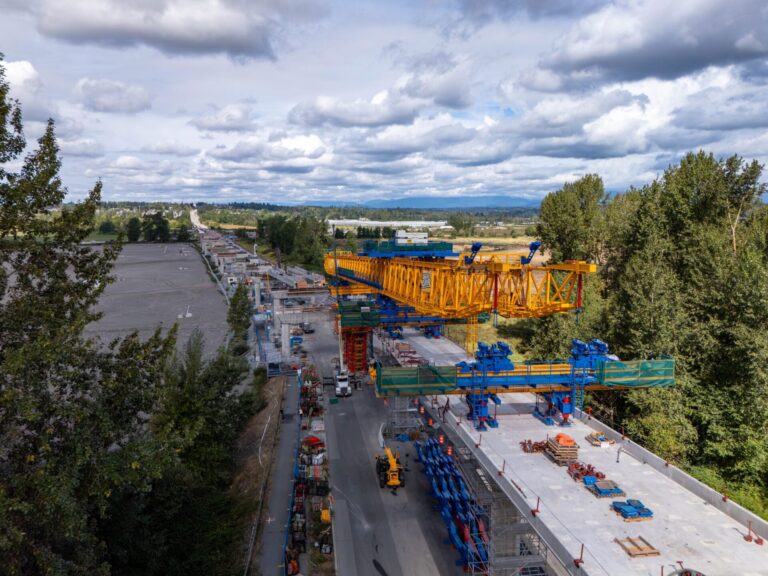
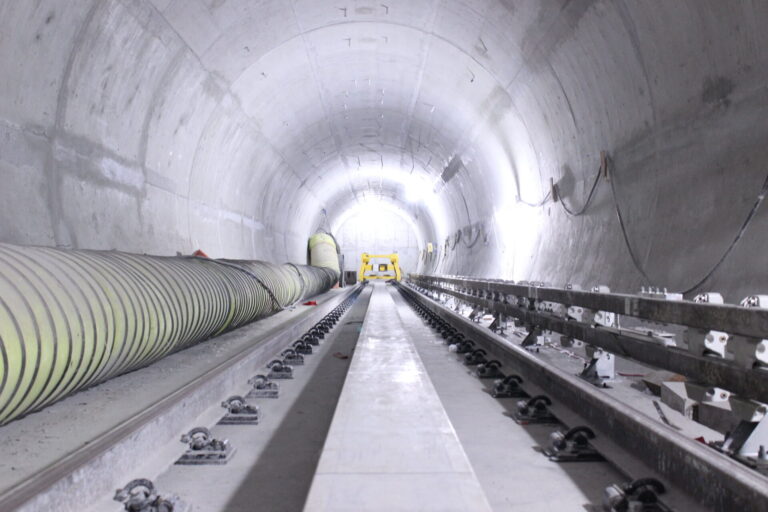
Transportation infrastructure: The AtkinsRéalis-AECOM and CDPQ Infra engineering consortium for the Réseau express métropolitain (REM) – Deux-Montagnes branch. Through close collaboration, technological innovation, and advanced BIM, the AtkinsRéalis-AECOM engineering consortium delivered an automated, sustainable, and integrated infrastructure, improving mobility, the environment, and the quality of life for future generations in the Montreal region.
Urban infrastructure: AtkinsRéalis and the City of Montreal for Place des Montréalaises. This project, located above the Ville-Marie Expressway, connects downtown to Old Montreal. The inclined triangular deck in post-stressed concrete and the ellipsoidal column with its evolving shape compose this space dedicated to Montreal women, including the 14 victims of the Polytechnique massacre.
International: AECOM and Millennium Challenge Account – Côte d’Ivoire (MCA-CI) for the execution of a mandate to ensure the environmental and social compliance of a major project improving traffic flow and road safety in Abidjan. Its implementation relied on exemplary coordination by AECOM among multiple stakeholders and on innovative approaches that effectively addressed complex and evolving urban challenges.
Consulting Engineering Mentor of the Year: Jean-Marc Lauzon of Groupe ABS . A seasoned hydrogeologist, Jean-Marc Lauzon has dedicated over 35 years of his career to science, a commitment to excellence, and talent development. A generous and humble mentor, he instills rigor, curiosity, and a passion for science, leaving a lasting impact on the next generation, his organization, and the Quebec environmental community.
SME consulting engineers: Côté -Jean et Associés and Forêt Hereford collaborated on the Mount Hereford observation tower. Nestled above the Mount Hereford forest, this observation tower offers a 360-degree view. Behind its apparent lightness lies a complex structure, custom-designed to withstand extreme winds. An engineering feat that transforms a viewpoint into a truly immersive experience.
Engineering consulting talent:
- RomiAnne Beaudoin of the firm AECOM , in collaboration with the Ministry of Transport and Sustainable Mobility (MTMD) , for section 2 of the Gaspé railway. In this major project, RomiAnne Beaudoin distinguished herself through her technical expertise, sound judgment on the ground, and leadership. She contributed to the stabilization of the infrastructure and the safe resumption of rail transport after more than 10 years of inactivity.
- Karolane Bédard of AtkinsRéalis , in collaboration with the National Capital Commission of Quebec , for Phase 3 of the Samuel-de Champlain Promenade. Karolane Bédard actively contributed to the design and oversight of this major project. Her exemplary involvement and key role in the project’s success demonstrate her leadership and technical expertise.
Technology: WSP Canada and Telus for the installation of a submarine fiber optic cable. TELUS has mandated WSP to optimize the route of a submarine cable between Sainte-Anne-des-Monts and Sept-Îles in order to integrate environmental and social issues, characterize landing sites, obtain permits, conduct consultations, and then perform environmental monitoring using thermal imaging and automated real-time detection.
Featured image: (AFG)