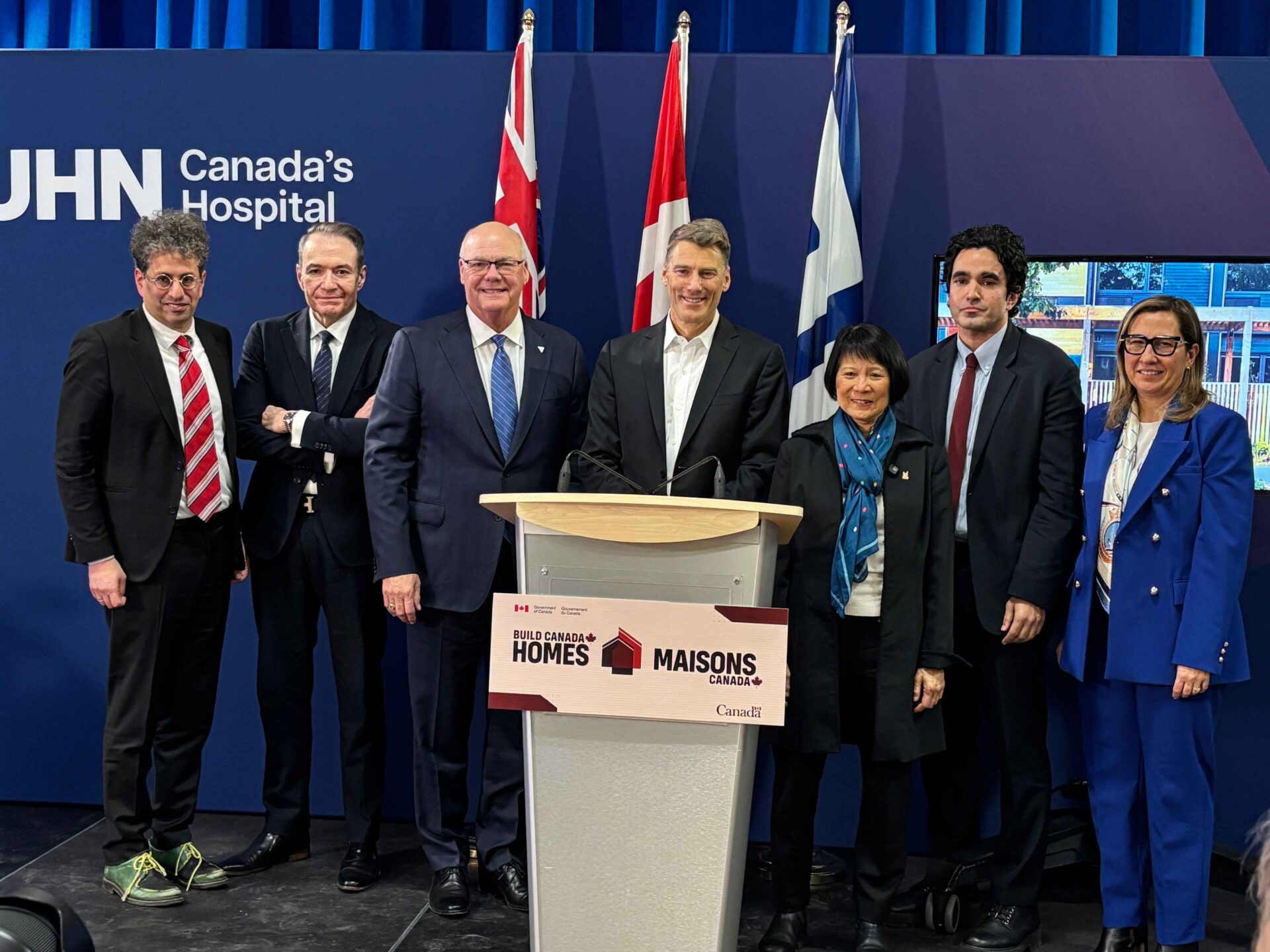

The Government of Canada announced that through Build Canada Homes, the Province of Ontario and the City of Toronto it is partnering with the University Health Network (UHN) to support the creation of Dunn House Phase 2, which will provide new supportive housing in Toronto’s Parkdale community.
The federal government is investing $21.6 million for the development, with the Province of Ontario providing up to $2.6 million in annual operational funding, and the City of Toronto leading the delivery of these new homes as a public developer.
“Investing in projects like Dunn House Phase 2 is critical to solving the housing crisis at all ends of the spectrum. This investment will deliver urgently needed supportive housing for those who need it most. By embracing modern construction methods, we can reduce build times, cut material waste, and lessen environmental impacts. When we pair innovation with compassion, we create homes that strengthen communities and provide vulnerable Canadians with the stability and care they deserve,” said Gregor Robertson, Minister of Housing and Infrastructure.

Dunn House Phase 2 will build on the success of Canada’s first-ever Social Medicine Housing initiative. Phase 2 will deliver 54 rent-geared-to-income studio units for at-risk seniors, with all residents having access to health and social services on-site. On behalf of the City, CreateTO will develop the site using modular construction to reduce costs and accelerate delivery, helping to get homes built faster for those who need them most.
“Building on the success of Dunn House, Phase 2 exemplifies what is possible when every partner pulls in the same direction. By bringing together all orders of government, a leading healthcare institution, and committed nonprofit organizations, we are delivering a model of supportive housing that is greater than the sum of its parts. These partnerships are at the heart of Build Canada Homes’ mandate — they allow us to accelerate delivery, drive innovation, and ensure that projects like this meet the real needs of communities,” said Ana Bailão, CEO of Build Canada Homes.
Phase 2 reflects a highly collaborative, community-driven approach. The model was developed by the University Health Network’s Gattuso Centre for Social Medicine, the City of Toronto, and community partners. It recognizes that stable housing is a cornerstone of good health and integrates supports that address key social determinants of health, including housing stability, food security and access to care.
“Dunn House has generated strong early evidence demonstrating the essential role of secure housing in improving health outcomes for individuals for whom emergency departments too often serve as the front door to care. We are deeply grateful to our government partners for their historic investment, which enables the next phase of this work—applying the Dunn House model to provide focused housing for at-risk seniors who are frequent users of emergency rooms, strengthening the continuum of care while reducing avoidable strain on the healthcare system,” said Dr. Kevin Smith, president and CEO of University Health Network
“We are proud to be collaborating with the Government of Canada and the Province of Ontario on Dunn House Phase 2. The first phase demonstrated that social medicine supportive housing can significantly improve care while providing stable homes. We are excited to expand this work with our federal and provincial partners. It is exciting to see all levels of government working together to build a safer, more affordable, and caring city,” said Mayor Olivia Chow, City of Toronto.
Featured image: (UHN)