The Government of Canada has officially launched the Build Communities Strong Fund and detailed its first projects, totalling $300 million in construction spending.
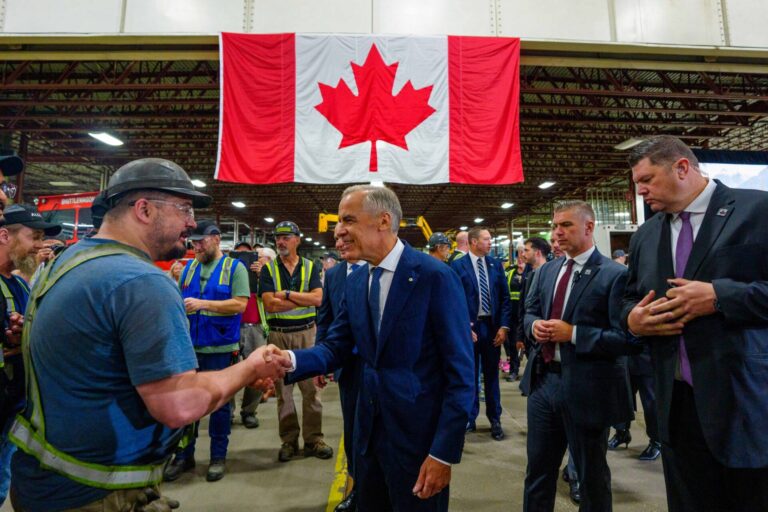
The announcement was made by Prime Minister Mark Carney in Brampton, Ont., the location of one of the first series of 13 projects under the Build Communities Strong Fund across the country.
“Canada’s new government is on a mission to build big things, including the local infrastructure that brings Canadians together. With the Build Communities Strong Fund, we are partnering with provinces and territories to move projects forward, reduce barriers to building, and deliver the housing and infrastructure Canadians need – from hospitals and transit lines to bridges and community centres. We are building communities strong to build Canada strong for all,” said Prime Minister Carney.

The new Embleton Community Centre and Park in Brampton will receive a $64 million investment to build what will become a 175,000-square-foot community centre with a pool, gymnasium, fitness centre, childcare facility, as well as various community spaces and outdoor recreational amenities.
“The Embleton Community Centre is a promise to every family in southwest Brampton that their city sees them, hears them, and is investing in them. A $64 million federal commitment through the Build Communities Strong Fund, combined with the $148 million our Council has already approved, means we are building something truly extraordinary that will serve generations to come. I am proud to welcome Prime Minister Carney and Minister Gregor Robertson to our great city and grateful for our federal partners who understand that investing in local communities like Brampton is investing in Canada,” said Patrick Brown, Mayor of Brampton.
In addition to the Embleton Centre and Park, the first tranche of projects include:
- Cornwall, Prince Edward Island: Launching Phase 1 of the Cornwall Road Extension of Water and Wastewater project, extending water and wastewater mains to support growing residential and commercial development.
- Bridgewater, Nova Scotia: Upgrading sewer lines to improve wastewater service and unlock future residential housing construction in the community.
- Halifax, Nova Scotia: Extending water and wastewater infrastructure on Windsor Street to support residential growth.
- Iqaluit, Nunavut: Enhancing trucked and utilidor infrastructure to support the development of 2,000 to 2,500 new housing units by 2031, addressing the city’s housing shortage and accommodating population growth.
- Quispamsis, New Brunswick: Expanding the Hampton Road water distribution system to enable the development of up to 1,055 housing units by extending the watermain network by 1.5 kilometres.
- Hay River, Northwest Territories: Building a new water treatment facility to replace the aging system currently serving the town of Hay River and its surrounding communities, including the Hamlet of Enterprise, K’atl’odeeche First Nation, and Ka’a’gee Tu First Nation.
- Laval, Québec: Redesigning Labelle, d’Orly, and St-Hubert streets, and developing Labelle East Street in preparation for the redevelopment of the Cartier sector.
- Headingley, Manitoba: Building a water reservoir and pumping station in the municipality of Headingley, adding 3,600 cubic metres of water storage and 65 litres per second of pumping capacity, while supporting the development of 1,771 additional housing units.
- Regina, Saskatchewan: Upgrading the South Trunk sewer to address existing capacity limitations, reduce the risk of basement flooding and untreated discharges into Wascana Creek, and support future growth in the city’s southeast and southwest areas.
- St. Albert, Alberta: Expanding wastewater, stormwater, and water systems in northeast St. Albert.
- Vancouver, British Columbia: Investing inthe new Marpole Community Centre, a fully electric, zero‑carbon, and highly energy‑efficient facility that will include childcare, after‑school care, a gym, a sensory room, and multipurpose spaces.
- Whitehorse, Yukon: Constructing the Whistle Bend Active Transportation Corridor, connecting Whistle Bend to downtown Whitehorse to improve active transportation infrastructure in the community.
The Federation of Canadian Municipalities (FCM) welcomed the launch of the Build Communities Strong Fund, which the organization said signals a growing recognition that local infrastructure is essential to delivering for Canadians.
“Municipal infrastructure is where people feel progress first,” said FCM President Rebecca Bligh. “It is clean water when you turn on the tap, safer roads on the way to work, and the capacity a neighbourhood needs to support new homes. Municipalities are working with the federal government to deliver infrastructure projects this construction season. We stand ready to ramp up delivery in partnership with the federal government.”
The Build Communities Strong Fund delivers funding through three major streams:
A provincial and territorial stream: $17.2 billion over 10 years to plan, build, and deliver critical public infrastructure projects across provinces and territories through bilateral agreements. Provinces will be required to cost-match federal investments and take action to reduce the cost of construction, including for housing-related infrastructure, through reductions to development charges where they pose a barrier to housing construction. This stream includes funding for:
Health-related infrastructure: A dedicated investment of $5 billion over three years in health infrastructure funding to prioritize upgrades to critical health infrastructure, including hospitals, urgent care centres, and facilities for palliative care, mental health care, and long-term care.
Housing-enabling infrastructure: Projects that support and enable housing supply, including water and wastewater systems, roads and bridges, public transit, and community infrastructure.
Infrastructure at colleges and universities: The construction of new facilities or rehabilitation of aging facilities and upgrades to learning and research spaces.
A direct delivery stream: $6 billion over 10 years to deliver regionally significant projects and important local infrastructure, including large building retrofits, climate adaptation infrastructure, and community infrastructure such as new community and recreational spaces. Eligible project proponents can submit proposals starting today.
A community stream: $27.8 billion over 10 years for the construction and rehabilitation of essential local infrastructure such as local roads, bridges, water systems, and community centres.
Featured image: (Government of Canada)