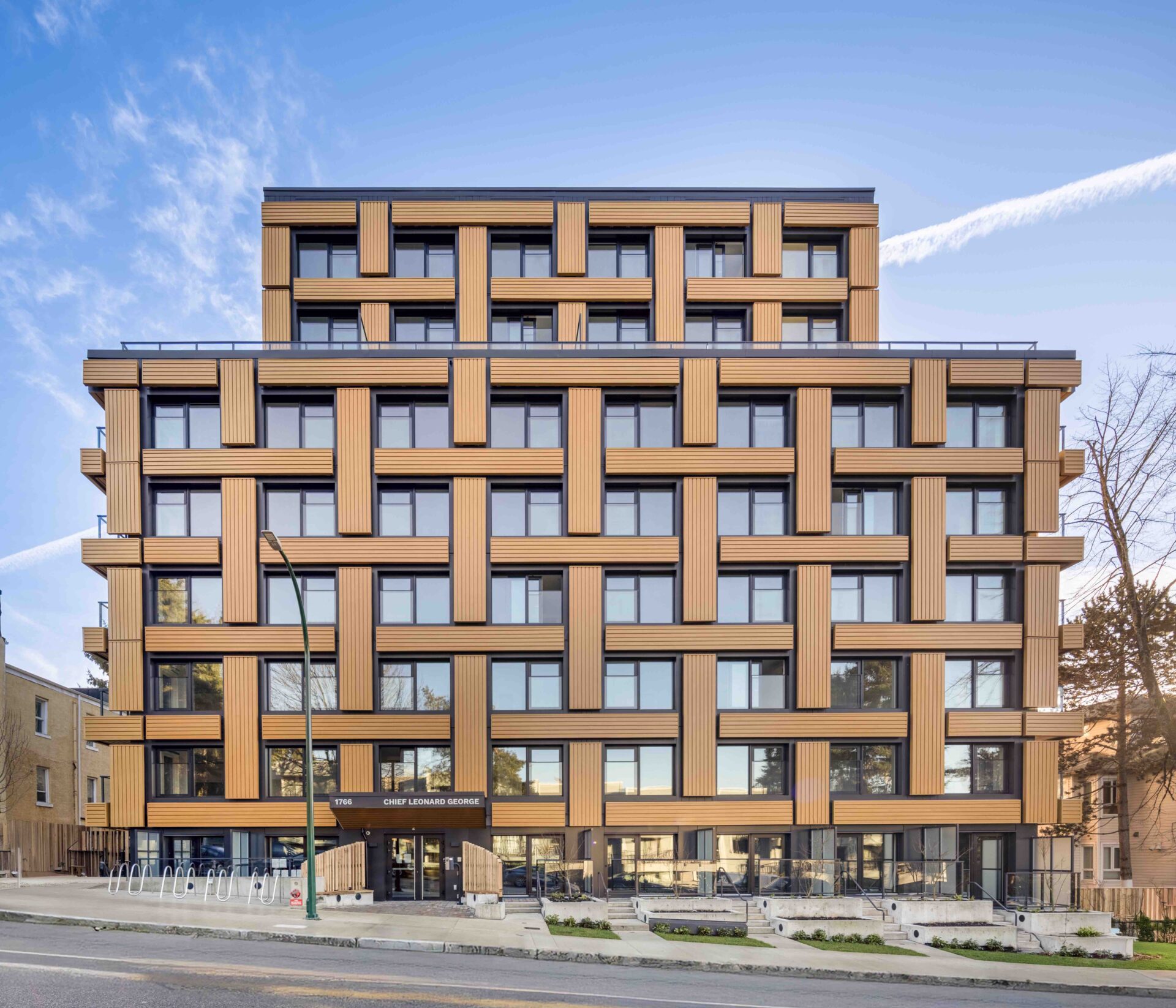

GBL Architects celebrated the completion of Canada’s first tall timber Passive House building for the BC Indigenous Housing Society (BCIHS). This 81-unit purpose-built rental housing project comprises a childcare facility, studio units and several three- and four-bedroom suites for Vancouver’s Indigenous community.
The nine-storey building marks a new standard for affordable housing and environmental stewardship, achieving a 75 per cent reduction in embodied carbon and GHG emissions through the innovative use of locally sourced mass timber floor panels, pre-manufactured CLT envelope panels, and Passive House certification. While mass-timber construction plays a significant role in reducing a building’s embodied carbon, the Passive House design reduces operational carbon emissions.
The highly expressive façade is envisioned as a woven cedar basket, in celebration of traditional Coast Salish basketry, one of the oldest art forms on the Northwest Coast. These baskets are living expressions of cultural identity, women’s leadership, knowledge of local ecologies, and the continuity of teachings passed from one generation to the next.
Referencing these woven forms in the Chief Leonard George Building links an innovative mass-timber, all-electric Passive House project directly to these lineages of care, resilience and connection to land. “For generations, these cedar baskets have carried food, medicines and children. This building follows that teaching as a contemporary basket that holds families, culture and community in an urban setting,” says Achim Charisius, Associate Principal of GBL Architects and certified Passive House designer.
“We often use the basket as a metaphor for the weaving of generations in our families. The basket is also a metaphor for how we used to live together. Its symbolism is meaningful to our organization as we seek to bring back traditional ways of living together,” says Brenda Knights, Chief Executive Officer of BCIHS.
The building is situated in Vancouver’s Grandview-Woodland neighbourhood, east of historic Chinatown and Strathcona, an area appreciated for its ethnic diversity and proximity to the popular Commercial Drive.
The Chief Leonard George Building provides intergenerational living, community services, and employment opportunities, reflecting BCIHS’s four pillars: good governance, economy, community services, and culture. The project is a model for future affordable housing development and includes amenities such as a seventh-floor outdoor space with views toward the North Shore mountains and Vancouver Harbour, a childcare on the ground floor, and units that accommodate large Indigenous families.
“Too often in society, we have families that are segregated from each other, with inadequate community support. Chief Leonard George’s amenity spaces allow tenants to experience the outdoors in a safe place and gather for cultural programming,” adds Knights. The childcare will offer before-and after-school care, supporting working families. The landscape design incorporates drought-resistant and medicinal plants. The building will also provide space for cultural programming, including drum workshops and language classes.
The new structure replaced the previous apartment building, which was destroyed by a fire in 2017, displacing dozens of families, many of whom lost their entire possessions.
The massing and unit layout are optimized to utilize standard cross-laminated timber floor panel dimensions. Custom-designed cross-laminated envelope panels were robotically pre-manufactured and then combined with steel columns and a concrete core to complete the structural design. Optimizing south-facing windows takes advantage of passive heating in winter, while fewer windows on east- and west-facing façades prevent overheating in summer.
“We’re pleased to design a building with a mix of unit sizes, with a focus on larger units to accommodate Indigenous families. For added livability, the north-facing suites have oversized tilt-and-glide windows that open out to spectacular views of the mountains and water beyond, while south-facing units include generous balconies,” says Charisius. The thermal-bridge-free design, including externally supported balconies, helps achieve an airtight envelope. The building features high-efficiency heat-recovery ventilation and thick wall assemblies, enabling Passive House certification with an energy demand of 13 kWh/m2/year.
“Wood plays an important role for Indigenous communities, so the mass timber construction is significant to us, not just for sustainability purposes, but to be exposed to natural materials to encourage health and well-being,” says Knights. “We are pleased the architects were able to bring back a wonderful sense of community for tenants, and where families can thrive in a positive environment.”
Featured image: (About GBL Architects)