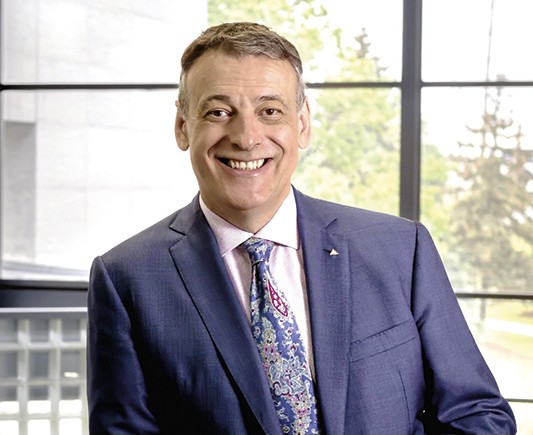

When Hatch CEO John Bianchini describes the experiences that shaped his leadership, he points not to boardrooms or strategy papers, but to thousands of miles traveled, many cultures encountered, and early lessons learned from mentors who shaped his thinking. “Reflecting on my career,” he says, “working around the world has been absolutely critical to my development as the leader I am today.”
It’s a theme that runs through Bianchini’s story: leadership built not through hierarchy, but through immersion, observation, and a deep commitment to understanding people.
A global career
In the early years of his career, Bianchini found himself on the move—supporting projects abroad as Hatch expanded into new markets. He calls these years formative. “Early in my career, I had the opportunity to travel extensively, assisting in the development and improvement of metallurgical processing facilities as Hatch expanded its global footprint to serve our clients around the world.”
Later, he and his family lived in three countries—Canada, South Africa, and Australia—experiences that profoundly shaped his understanding of leadership and culture. “These firsthand experiences immersed in various cultures and markets have been transformative,” he says. “They taught me the importance of building trust, adapting to diverse environments, and leading teams across six continents with empathy and understanding.”
For Bianchini, these global experiences didn’t just help him grow—they continue to guide him as CEO. “Having this global perspective is indispensable,” he explains. “It enables me to guide our international organization with confidence, drawing from a wealth of experiences and insights gained from my time abroad.”
A career built on mentorship
When Bianchini joined Hatch in 1985 as a graduate chemical engineer straight out of the University of Toronto, he could not have known how deeply the firm—and its founder, Dr. Gerald Hatch—would influence his approach to leadership.
He often recalls one of Dr. Hatch’s most enduring lessons: “One of his most memorable pieces of advice was to always ‘do your homework.’” But the phrase meant more than being technically prepared. “This wasn’t just about mastering the engineering fundamentals,” Bianchini explains, “but also about taking the time to understand people—what drives them, and how to help them succeed.”
This balance between technical rigor and deep human understanding would become a hallmark of his leadership. As his career advanced through roles as project manager, global managing director, and ultimately CEO, he held firmly to values of collaboration, mentorship, and ownership.
“It’s this rich experience that inspired me to create leadership development programs aimed at mentoring and challenging young professionals,” he says. “Many of these individuals have now risen to senior leadership positions within the company.”
For Bianchini, leadership is fundamentally about unlocking the strengths of others. “True leadership is about enabling others to succeed and fostering a culture of integrity and curiosity.”
Transforming Hatch’s brand
When Bianchini stepped into the CEO role, he inherited a firm known globally for its technical excellence. But he had a broader vision—one that positioned Hatch as a force for innovation, sustainability, and societal impact.
“My vision was to elevate Hatch beyond just engineering excellence,” he says. “I aspired for us to be synonymous with creating positive change.”
Under his leadership, the firm’s brand evolved to reflect not only its technical capabilities, but its contributions to communities, its partnerships with STEM institutions, and its philanthropic engagement in healthcare and the arts. “Recognizing that the world and our clients’ needs were evolving, with ever growing challenges, we expanded our Hatch family to include experts in digital, climate change, advisory, and urban development.”
Another key part of this transformation has been strengthening Hatch’s Manifesto—the document that articulates the purpose and values that guide the company. “This guiding document defines our purpose, our actions, and our values all of which guide our behavior,” Bianchini explains. “It commits us to the pursuit of positive change, addressing the world’s toughest challenges, and delivering practical solutions that are safe, innovative, and sustainable.”
Projects in action
Although Bianchini is quick to say he is proud of all the company’s projects, a few represent defining examples of Hatch working at its best. One is the firm’s work with the Nuclear Waste Management Organization. “Our work with the NWMO on Canada’s first deep geological repository is groundbreaking for nuclear waste management,” he notes. “It’s a great example of bringing all of Hatch to a project with our mining, energy, and infrastructure teams working together on the best solutions.”
Another project he highlights is the Wataynikaneyap Power Transmission Project, which he describes with particular pride. “We were privileged to be a part of the Wataynikaneyap Power Transmission Project and to be able to help bring the vision of 24 First Nations to life with 1,800 km of transmission lines and 22 substations to power 17 remote communities.” It is, he says, “the largest Indigenous-led electricity project in Canadian history,” and one that brings transformative benefits: “delivering reliable energy to the communities and eliminating the need for the emissions-intensive diesel generators.” For Bianchini, this project represents the very essence of Hatch’s purpose: “To me, it’s the definition of creating positive change.”
A Passion for philanthropy
For Bianchini, Hatch’s commitment to positive change extends far beyond engineering. He often speaks about the company’s responsibility to contribute meaningfully to society. “At Hatch, we live our Manifesto beyond the projects we deliver,” he emphasizes. “Wherever we work, our conviction is that communities touched by our work must be left better because Hatch was there.”
Hatch’s guided giving program reflects this commitment. “Our guided giving program is driven by three pillars: employee-led community initiatives, support for STEM education, and championing the arts.” This year alone, “we’ve invested over $6 million in community programs,” much of it driven by employee involvement that the company proudly matches.
Education is a cornerstone of this giving. “We provide more than $2 million in scholarships to help students in science and engineering become tomorrow’s innovators,” Bianchini says. Hatch also works to improve diversity in STEM. “We have committed $250,000 to support women in STEM research at Université de Sherbrooke and continue to expand opportunities for underrepresented groups.”
Bianchini also champions the importance of the arts—a passion deeply aligned with Hatch’s belief in the “renaissance engineer.” As he explains, “The arts are another defining expression of our values.” Hatch supports leading cultural institutions, including the Royal Ontario Museum and the Canadian Opera Company, because creativity fuels technical excellence. “Supporting the arts is not just about patronage; it’s about fostering a culture that values creativity and innovation,” he says. “The arts challenge us to think differently… It makes us better engineers and scientists.”
Last summer, Bianchini was recognized by OCAD University for his exceptional achievements in the arts and culture sector with an Honorary Doctor of Laws.
He says his vision around the connectedness of engineering and art is embodied in the Hatch Gallery of Contemporary Art at the company’s Mississauga headquarters. Opened in 2017, the gallery serves as inspiration to Hatch’s workforce.
“The arts have always been a powerful source of inspiration in my life and work. I believe that creativity and innovation—whether in art or engineering—are essential to solving the complex challenges we face,” said Bianchini at the university’s convocation ceremony, where he received his honorary degree. “This honor reaffirms my commitment to fostering a stronger connection between the arts and sciences, and to supporting the vibrant cultural institutions that enrich our communities.”
Across continents, disciplines, and decades, Bianchini’s leadership philosophy has remained grounded in a simple but powerful premise: that technical excellence and human understanding are inseparable.
As he puts it, “It’s about creating an environment where people feel valued, supported, and inspired to reach their full potential.”
John Tenpenny is the Editor of ReNew Canada.
[This article appeared in the January/February 2026 issue of ReNew Canada.]
Featured image: (Hatch)