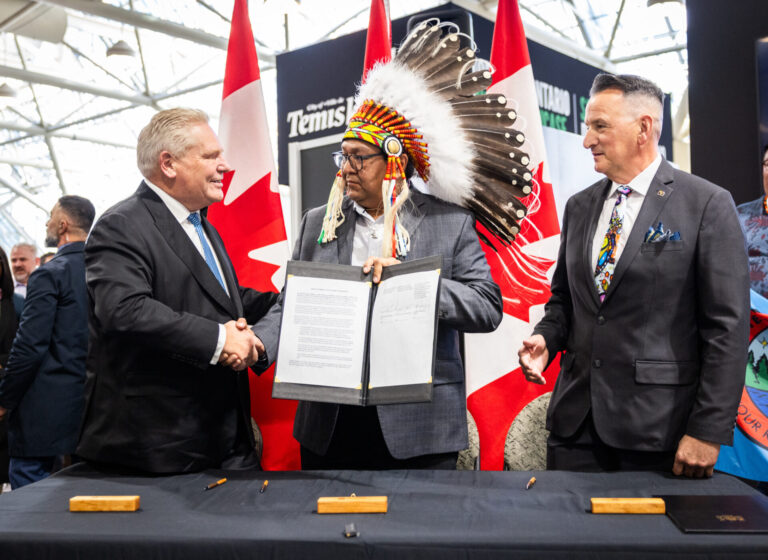
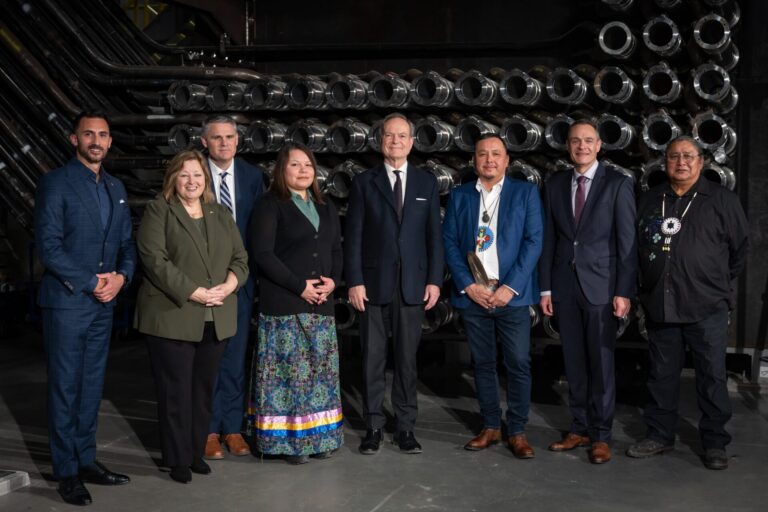
The Tłı̨chǫ Government and the Government of the Northwest Territories (GNWT) have signed a Memorandum of Understanding (MOU) to jointly assess the potential for a Tłı̨chǫ Government-owned hydroelectric project on the La Martre River.
A feasibility study will evaluate the proposed Nàı̨lı̨ı̨ Power Project, a hydroelectric generating station to be owned by the Tłı̨chǫ Government and located at or near Whatì Falls. Both governments acknowledge that any project resulting from the study would be situated on Tłı̨chǫ lands, where the Tłı̨chǫ hold rights as set out in the Tłı̨chǫ Agreement.
“The Tłı̨chǫ Government has been involved in power generation for many years, including leading the first 100 per cent Indigenous-owned hydro project in Canada through Snare Cascades. That experience guides how we approach new opportunities on our lands,” said Jackson Lafferty, Grand Chief, Tłı̨chǫ Government. “The Nàı̨lı̨ı̨ Power Project is an important step in understanding what is possible for our communities. This feasibility work will help us determine whether it strengthens our self-sufficiency and creates lasting benefits for the Tłı̨chǫ people.”

According to both parties, a new hydro facility connected to the Snare system could help reduce reliance on diesel across five communities during drought conditions, while supporting resilient, low-carbon economic growth in the Northwest Territories. To advance this work, the governments will establish a joint technical working group to oversee the feasibility study and provide updates and recommendations over the term of the MOU.
“As we continue the work of improving and advancing strategic infrastructure across the Territory, the Nàı̨lı̨ı̨ Power Project is a reflection of how we want to build infrastructure in the North through strong partnerships with Indigenous governments. Situated in an area that meets the conditions for clean and reliable energy, this project will bring additional hydro capacity online, improving the resilience of our system, and also result in new opportunities and benefits for the Tłı̨chǫ people and Northerners,” said Caroline Wawzonek, Minister Responsible for Strategic Infrastructure, Energy and Supply Chains.
The governments will jointly seek potential sources of funding to support planning and construction, including from the federal government and its agencies. Leveraging federal funding programs such as the Arctic Infrastructure Fund, private investment, and other sources of financing including the Canada Infrastructure Bank, will be a priority.
Feature image: (Tłı̨chǫ Government)