
The mods are back. No, not the Vespa-riding, army coat wearing subculture featured in The Who’s rock opera Quadrophenia. Rather, the concept of modular construction—the practice of fabricating building components, or “modules,” in a factory-controlled environment—has resurfaced as governments explore innovative construction methods to meet the challenges of building new infrastructure, particularly affordable housing and long-term facilities.
Some estimates suggest 4.3 million more homes for people with low incomes, students, and the homeless are needed, not to mention 199,000 new beds in long-term care facilities by 2035. Add to this the fact that an estimated 700,000 workers in the skilled trades are expected to retire by 2028, and construction costs have risen by 51 per cent in recent years, and policymakers need solutions—and quickly—to catch up to rising demand as the population grows and the skilled labour force shrinks.
Build Canada Homes—a new federal agency created by Mark Carney’s government—announced it will focus on using cost-efficient and modern methods of construction such as modular. Through bulk procurement and long-term financing, Build Canada Homes hopes to mainstream these advanced methods of construction, which they indicate have the potential to cut building timelines by up to 50 per cent, reduce costs by as much as 20 per cent and lower emissions by approximately 20 per cent during construction.
“We will create an entirely new housing industry using Canadian technology, Canadian workers, and Canadian resources—and give builders the tools they need to build more, build sustainably, and build at scale,” said Carney at the announcement.
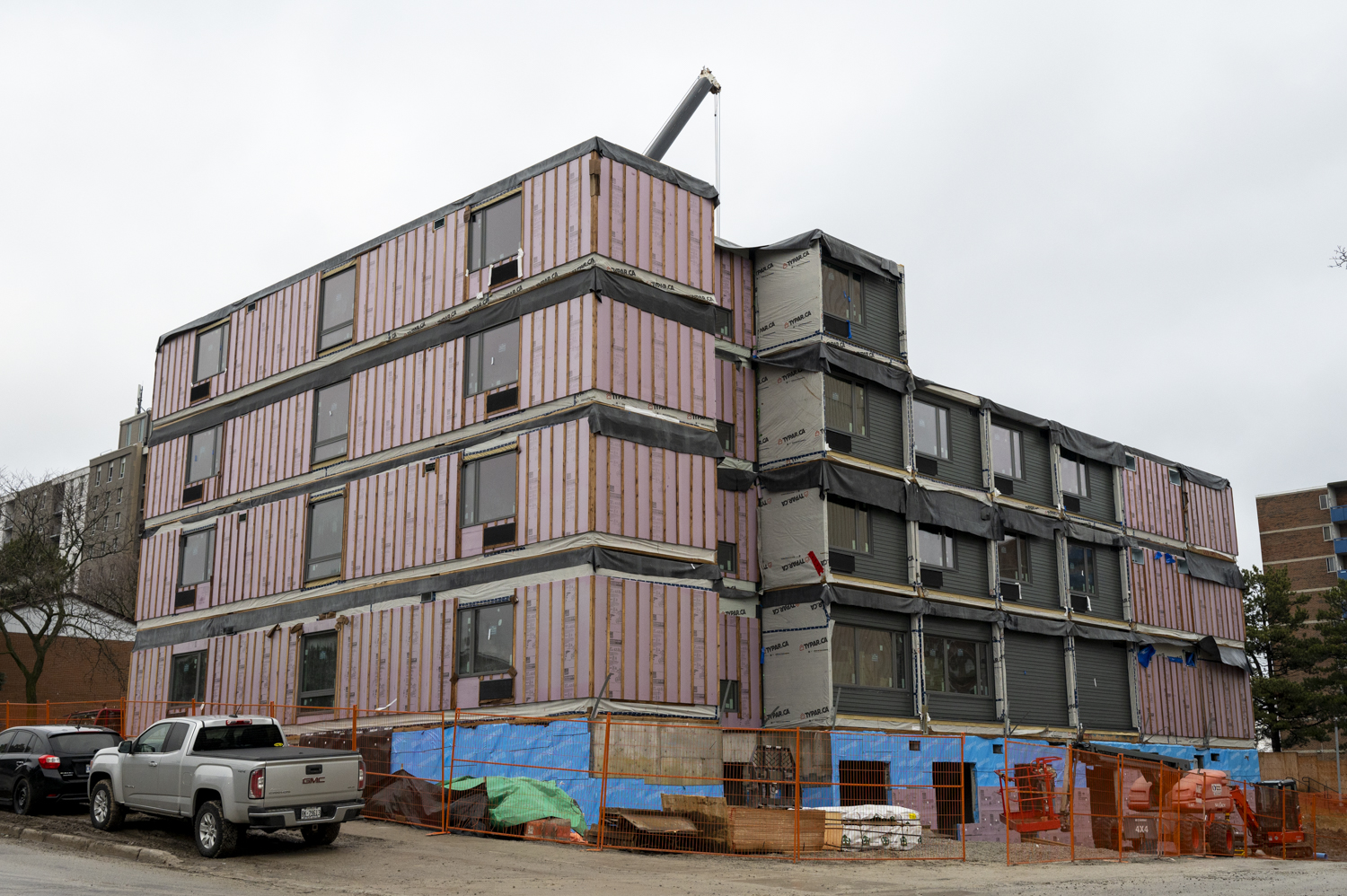
In Ontario and Quebec, modular construction is being used—in partnership with municipal governments—to make some headway in the affordable housing crisis.
The provincial government is partnering with the City of Toronto and Habitat for Humanity GTA to build 33 modular homes in a six-storey condominium building. The site was identified by the city as part of its commitment under the Ontario-Toronto New Deal to make use of surplus properties appropriate for the construction of below-market, attainable modular homes. Of the 33 modular homes, 22 will be large enough to accommodate families.
Ontario is investing $10 million in this project, with Toronto funding a further $4.8 million.
Recently, the City of Montréal officially opened its first modular housing project in partnership with the provincial and federal governments. This new project, with involvement from the Old Brewery Mission, will provide homes to 30 vulnerable individuals in a stable social situation who are on the housing waitlist. The modular housing units were designed reusing structures used for site offices by Hydro-Québec during the construction of the La Romaine hydroelectric project. These structures were redeveloped into 27 bedrooms, in addition to offices and common areas.
Other types of infrastructure, such as student housing, are being built using modular construction, as well as correctional facilities. In Ontario, several projects are under construction or have been completed using modular construction, including the Niagara Detention Centre, the Kenora Jail expansion, and the new $1.2-billion Thunder Bay Correctional Complex.
The benefits of modular construction can only be realized with broader awareness and understanding of modular methods, greater regulatory consistency, and more compatible procurement and financing practices.
John Tenpenny is the Editor of ReNew Canada.
[This article appeared in the November/December 2025 issue of ReNew Canada.]
Featured image: (City of Toronto)