
The City of London announced its 2026 Renew London program that includes approximately $285 million in new projects, along with another $100 million in ongoing work from last year.
Londoners will notice construction across major roads and intersections, as well as bridges, sidewalks, bike lanes, and transit routes.
According to the city, with more people comes greater demand on roads, transit, and other infrastructure. The Renew London program is building ahead, ensuring the city can support growth while keeping people moving safely today and into the future.

“London has experienced some of the fastest population growth in the country over recent years, so the scale of infrastructure investment we are undertaking is essential to meet our current and future needs,” said Mayor Josh Morgan. “With these funds we are building a smarter city that works for all residents by connecting neighbourhoods, supporting businesses, and keeping London moving safely.”
2026 Highlights
Some projects are major road upgrades on key routes, designed to reduce congestion, improve traffic flow, and support growth. Others focus on essential maintenance, such as fixing old roads, repairing bridges, and renewing water, storm, and sewer systems.
This work represents:
- more than 100 lane kilometres of road (about 250 laps around a running track)
- 20 intersections will be upgraded
- more than 30 kilometres of new or replaced water, storm, and sanitary infrastructure (roughly the length of 3,000 school buses lined up)
“The sheer scale of work this year reflects the city’s commitment to strengthening critical corridors, upgrading key intersections, and expanding capacity across London. Each project is carefully planned to ensure that as the city grows, the infrastructure is ready to support residents, businesses, and daily travel for years to come,” said Jennie Dann, Director of Construction and Infrastructure Services.
Construction in 2026 also includes continued work on the south and east Rapid Transit corridors, representing the final phases of London’s first approved routes. These projects will improve transit reliability, upgrade underground pipes and infrastructure, and help more people move efficiently through the city.
The year will also see more Infrastructure Renewal Projects (IRPs), where multiple improvements such as road, sewer, watermain and utility work are completed at the same time in neighbourhoods.
This coordinated approach fixes everything at once meaning fewer disruptions over time. Underground work, including sewer and water upgrades, remains just as important, even if it’s not always obvious to the public, as much of this critical work takes place below the surface.
2026 Top 10 Projects
Each year, the city highlights ten major construction projects that offer the largest benefits, impacts and scope of work. The 2026 Top Ten Projects include:
- Highbury Avenue South Road Rehabilitation – Improves travel between London and Highway 401, supporting regional economic growth.
- Phillip Aziz Avenue and Western Road Improvements – Makes the area near Western University safer and easier to travel for drivers, cyclists, and pedestrians.
- The Queen’s Bridge Rehabilitation – Rebuilds the bridge deck and key structures, adds a multi-use path for walking and cycling, upgrades pedestrian crossings, and strengthens shoreline protection.
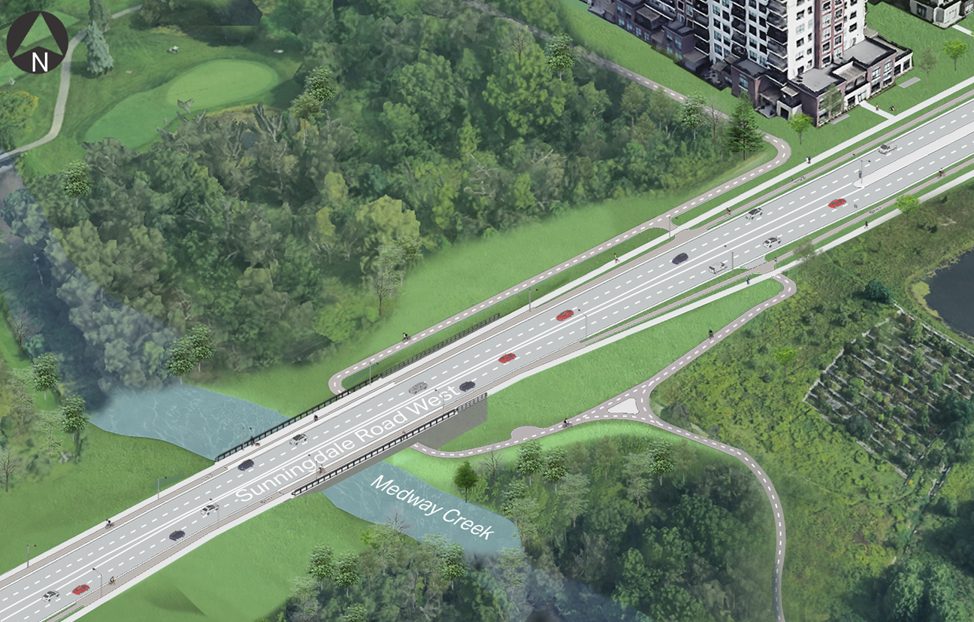
- Sunningdale Road West Improvements – Expands the road, improves safety, and supports future development in northwest London.
- Kilally Infrastructure Project – Updates the road and surrounding corridor to support growth and make active transportation safer and easier.
- Bradley Avenue Extension – Completes an important road connection to improve mobility and support city growth.
- Wellington Gateway Phase 2 – Final stages of the south Rapid Transit corridor, including road, transit, and underground infrastructure upgrades.
- East London Link Phase 3: Highbury Bridge – Replaces aging bridge structures, improves regional connections, and supports transit infrastructure.
- East London Link Phase 4: Oxford Street East – Continues construction along the corridor with upgrades to the roadway, active transportation options, and transit facilities.
- East London Link Phase 5: Dundas Street – Completes the East London Link corridor, allowing full Rapid Transit operations and supporting development in surrounding areas.
Advancing rapid transit
Rapid Transit remains a major part of London’s construction program, with significant progress already completed and the project now entering its final phases. As work continues on the Wellington Gateway and East London Link, the focus is shifting toward completing the remaining sections and preparing for the visible transformation above ground.
On Wellington Road, from Wilkins Street to Exeter Road, crews are finishing transit stations, traffic signals, multi-use paths, landscaping, paving, and painting red bus lanes. Phase 2, between Watson Street and Wilkins Street, will take the next two years to rebuild and widen the road, adding dedicated centre-running lanes for rapid transit buses.
On the East London Link, most construction on Dundas Street, between Egerton Street and McCormick Bouvelard, was completed in 2025. Crews will return in spring and summer 2026 for final paving and red bus lane painting. Work on Highbury Bridge will continue into 2026, and Phase 5 will begin in spring on Dundas Street. This next stage connects McCormick Boulevard through to Highbury Avenue, completing the corridor.
Featured image: Conceptual rendering of the Sunningdale Road West Improvements project. (City of London)