
The Canada Infrastructure Bank (CIB) has reached financial close with Potentia Renewables Inc. and M‑Squared Renewables on a $128 million project loan and a $36.4 million Indigenous equity loan towards the Rose Valley Wind project in Saskatchewan.
M‑Squared Renewables, an Indigenous development corporation, is owned by 10 First Nations, the nine Nations of the Meadow Lake Tribal Council and the Mistawasis Nêhiyawak First Nation. The CIB’s Indigenous equity loan enables M‑Squared Renewables’ majority ownership of the project, supporting a model designed to deliver long‑term economic reconciliation outcomes.
“With more than 34 projects benefiting Indigenous communities, Rose Valley Wind represents our sixth IEI loan and brings our total Indigenous equity investments across our portfolio to approximately $126 million. The Rose Valley Wind $164.4 million financing package enables First Nation ownership of the project, supports long-term economic benefits and also community reinvestment. M-Squared and Potentia’s partnership strengthens Indigenous participation while delivering dependable energy infrastructure, said Ehren Cory, CEO, Canada Infrastructure Bank.

“Closing the financing of the Rose Valley Wind project is an important milestone for Potentia and reflects the continued momentum of renewable energy development in Saskatchewan. This project brings together experienced financial partners and strong collaboration to deliver reliable, low-cost power while supporting long-term economic benefits for local communities,” said Ben Greenhouse, CEO, Potentia Renewables.
Located in the Rural Municipality of Excel No. 71 near Assiniboia, Saskatchewan, the project includes 28 wind turbines supporting up to a 210 MW power purchase agreement with SaskPower. The development also includes new and upgraded access roads, underground cabling, a new substation and supporting infrastructure.
“The Meadow Lake Tribal Council (MLTC), through its partnership in M2 Renewables, is proud to participate in the development of a 200 MW wind energy project in Saskatchewan. This project will provide clean, renewable power while providing long-term economic benefits for the nine nations of MLTC. Through our partnerships, we are helping build Saskatchewan’s energy future while advancing indigenous ownership, economic reconciliation, and self determination,” said Tribal Chief Jeremy Norman, Meadow Lake Tribal Council.
The CIB’s project loan helps to address the upfront capital costs associated with this buildout of renewable generation and minimizes potential ratepayer impacts.
Stable revenues for participating First Nations will support reinvestment in community priorities such as housing, elder facilities, youth programming and other social and community infrastructure. Construction is expected to create contracting and capacity-building opportunities across all ten Nations, alongside construction‑phase employment.
The project’s senior lenders include Desjardins Group, acting as administrative agent, and KfW IPEX-Bank.
Once operational, the project is expected to reduce energy emissions by approximately 297,807 t annually, contributing to Saskatchewan’s commitment to achieve net‑zero by 2050 while providing the capacity for residential and business growth in the region.
The project was selected through SaskPower’s 2024 Request for Proposals for new wind generation and is enabled under the CIB’s Clean Energy priority sector, which supports Canada’s transition to sustainable economic growth and long‑term energy security.
“SaskPower is using all tools at our disposal to ensure reliable and affordable power for our customers, while also supporting our growing economy and communities. Rose Valley will strengthen our diverse grid by supplying low-cost electricity for decades to come,” said Rupen Pandya, president and CEO, SaskPower.
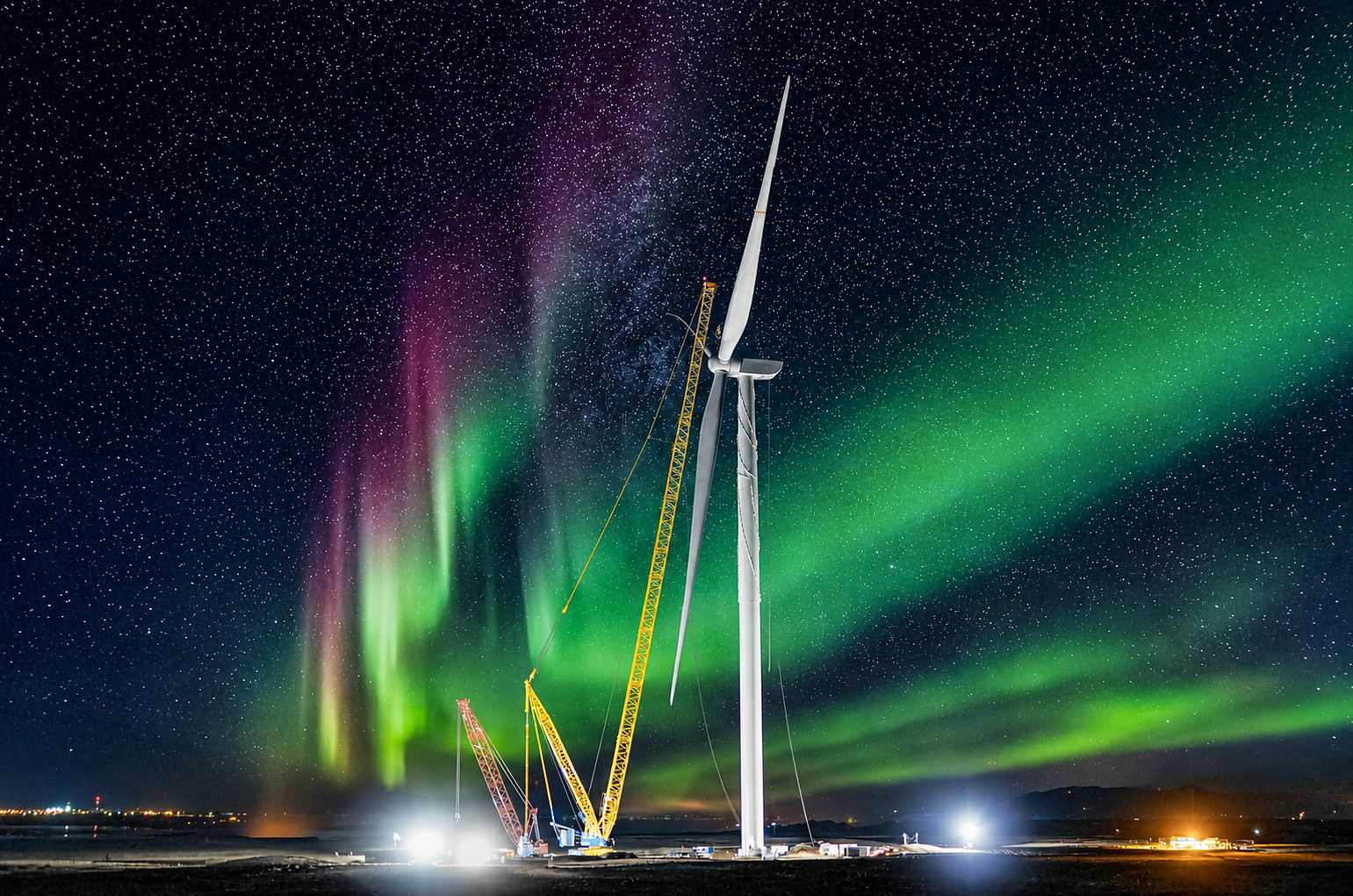
Featured image: Wind turbine under construction at night, illuminated by cranes and lights, with the northern lights visible in the sky above. (CIB)