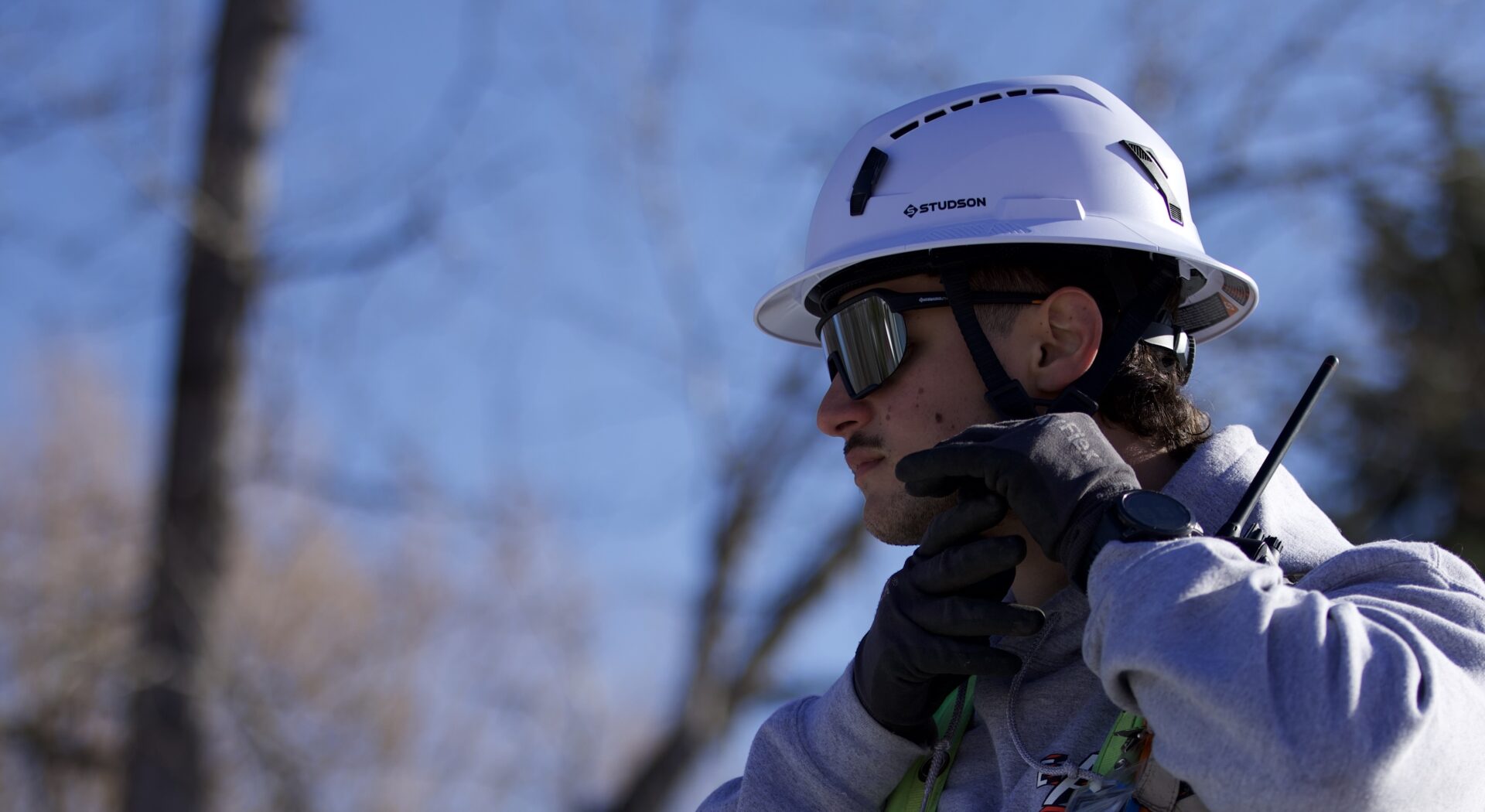

Guest author: Ryan Barnes, CEO & Founder, STUDSON
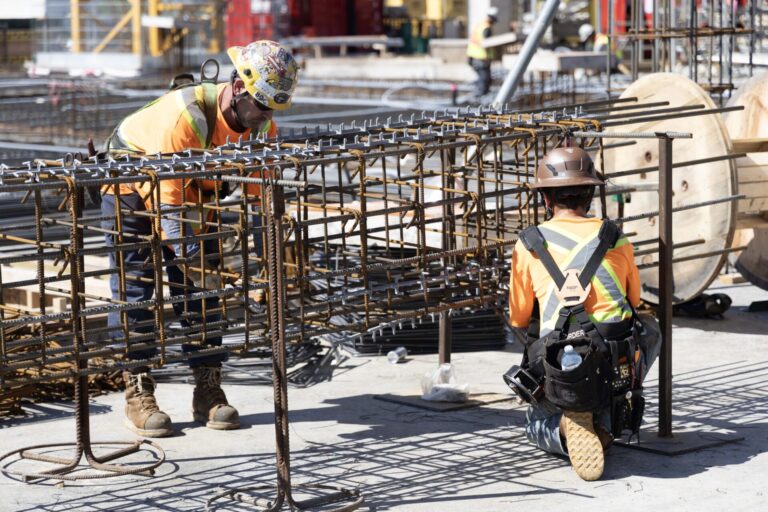
Walk any Canadian construction site today, and you’ll see two kinds of workers: those in Type II safety helmets, and those still wearing the hard hat they’ve had for years.
What the latter group may not realize is that the industry has already started moving — and the timeline to catch up is shorter than most expect.
Canada’s largest general contractors (GCs) have been leading the Type II charge for some time through internal safety research, field data, and peer influence that reaches across trusted professional networks. Now, the Canadian Construction Safety Council’s (CCSC) commitment to requiring Type II safety helmets across member projects by July 1, 2026, is evidence of a major change already underway.
The Hard Hat’s Soft Spot
Hard hats were engineered for one specific threat: objects falling from above — the assumed on-the-job risk for more than a century.
What the hard hat doesn’t do is protect a worker who falls, or who is struck from somewhere other than directly above.
Falls are the leading cause of death in construction. In the U.S., where comparable data is more robust, the Occupational Safety and Health Administration (OSHA) reports that in 2024, fatal falls accounted for more than 37% of total documented construction fatalities, with the U.S. Bureau of Labor Statistics adding that the industry represented nearly half of all fatal falls across all private industry that year.
Nonfatal falls to a lower level, requiring time away from work, occur in construction at more than three times the rate of all other private industries.
What’s key here is the mechanism of impact. When a worker falls, the impact is rarely straight down. Angled and oblique forces are what cause the brain to rotate within the skull, which produces the most severe traumatic brain injuries; these forces are ones that traditional hard hats simply weren’t designed to protect against. But Type II helmets are.
Built with top, front, side, and rear protection, and an integrated chin strap that keeps the helmet in place at the moment of impact — a feature largely missing from hard hats and Type I helmets — Type II helmets are engineered for the full range of impacts workers actually face.
An Industry Already Decided
So far, Canada’s largest GCs haven’t arrived at Type II through regulation; it’s been an inside job built upon what teams are seeing on the ground. When a major GC changes its own safety requirements, that shift doesn’t stay siloed — it becomes a site condition for subcontractors, a topic at the next association meeting, and a conversation that ripples out to other companies and, by extension, their sites.
That ripple is expanding. For many subcontractors, the companies they most want to work with have already made Type II a condition of site access. On July 1, the CCSC — an organization of world-class Canadian GCs, including EllisDon, Aecon, Bird, Pomerleau, and other influential GCs — will require the Type II transition for its member sites.
Type II, One Decision
It’s clear that urgency is warranted. But without thorough research, GCs risk choosing the wrong helmet, with crew adoption suffering as a result. Workers can and will find ways around gear that’s uncomfortable, heavy, or hot (and a helmet sitting in a locker doesn’t protect anyone).
Helmet wearability over a full shift — based on factors such as thermal regulation, weight distribution, ease of adjustment with gloves on, and, yes, how it looks on-site — varies vastly across the Type II market.
So does the compliance picture, and for different reasons. For companies operating across Canadian and American sites, or growing through cross-border acquisition, a helmet dual-certified to both CSA and ANSI standards removes a layer of friction that would otherwise require two separate procurement conversations.
STUDSON builds its Type II helmets around these practical realities and a simple premise: protection only works if the helmet is actually on.
To start, STUDSON’s designs run cooler — up to 4.5° C cooler, thanks to the use of Koroyd technology — which matters during a full summer shift when the temptation to remove headgear is at its highest. The FIDLOCK magnetic buckle closes with one hand, even with gloves on, reducing the friction that causes workers to skip the chin strap. In the event of an incident, the Koroyd impact system crumples on contact, absorbing those oblique and angled forces — meaningfully beyond what standard EPS foam provides. Twiceme Technology’s embedded NFC chip gives first responders immediate access to key health information — and supports compliance tracking without the paper trail that slows everything else down.
And for STUDSON, aesthetics aren’t an afterthought — they’re an integral part of the performance equation. Gear that workers are proud to wear is gear that actually gets worn.
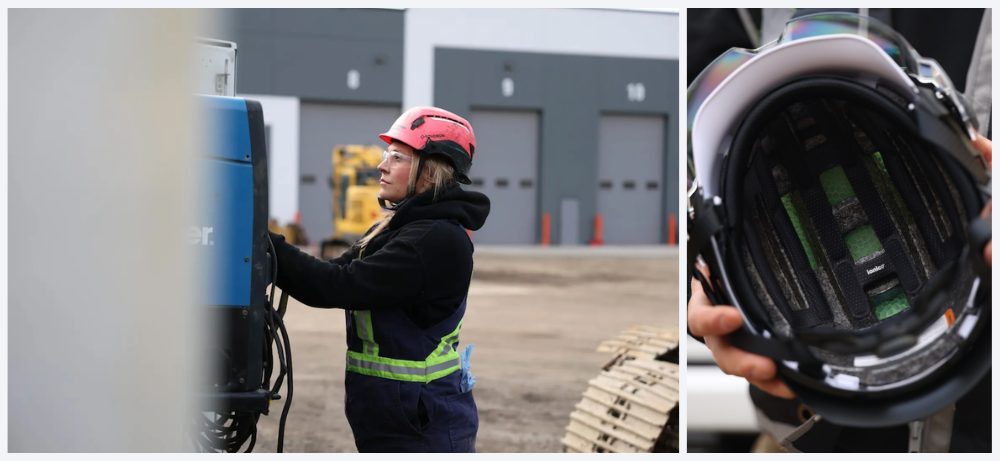
Images: STUDSON/SitePartners
These details compound and help GCs on both sides of the border feel confident that the Type II decision is one they only need to make once.
Keeping Up With The GCs
For Canadian construction companies still deliberating, the nation’s largest contractors have already made the call. The CCSC requirement formalizes it for an even wider circle of projects. So the question isn’t whether Type II becomes the standard; it’s whether your company gets there on its own timeline, or someone else’s.
Cover image: STUDSON/SitePartners
________________________________________________________
This article was produced in partnership with SiteMedia Content Studio.