
By Mark Cardwell
As official ceremonies go, the signing of the Commercial Notice of Operation for the sixth and final generating unit at BC Hydro’s Site C Clean Energy Project was a decidedly low-key affair.
But for project manager Chris Waite, who inked the official document on a Saturday morning last August in front of a handful of workers at the shiny new industrial facility on the Peace River in northern British Columbia, several hours after the unit had already become fully operational, it was a personal and team milestone moment that capped a decade of hard work and all-in commitment to the massive $16-billion dam and reservoir construction project.
“It’s rewarding to see the facility operating,” said Waite, director of construction management for BC Hydro and Site C project leader. “It was a real challenge that was met by an excellent team of people who were ambitious, driven and even a little bit crazy.”
Site C is now BC Hydro’s third hydroelectric dam on an 80-kilometre stretch of the Peace River, a 2,000-km-long waterway that flows east from the Rocky Mountains to Alberta where it merges with the mighty Mackenzie River.
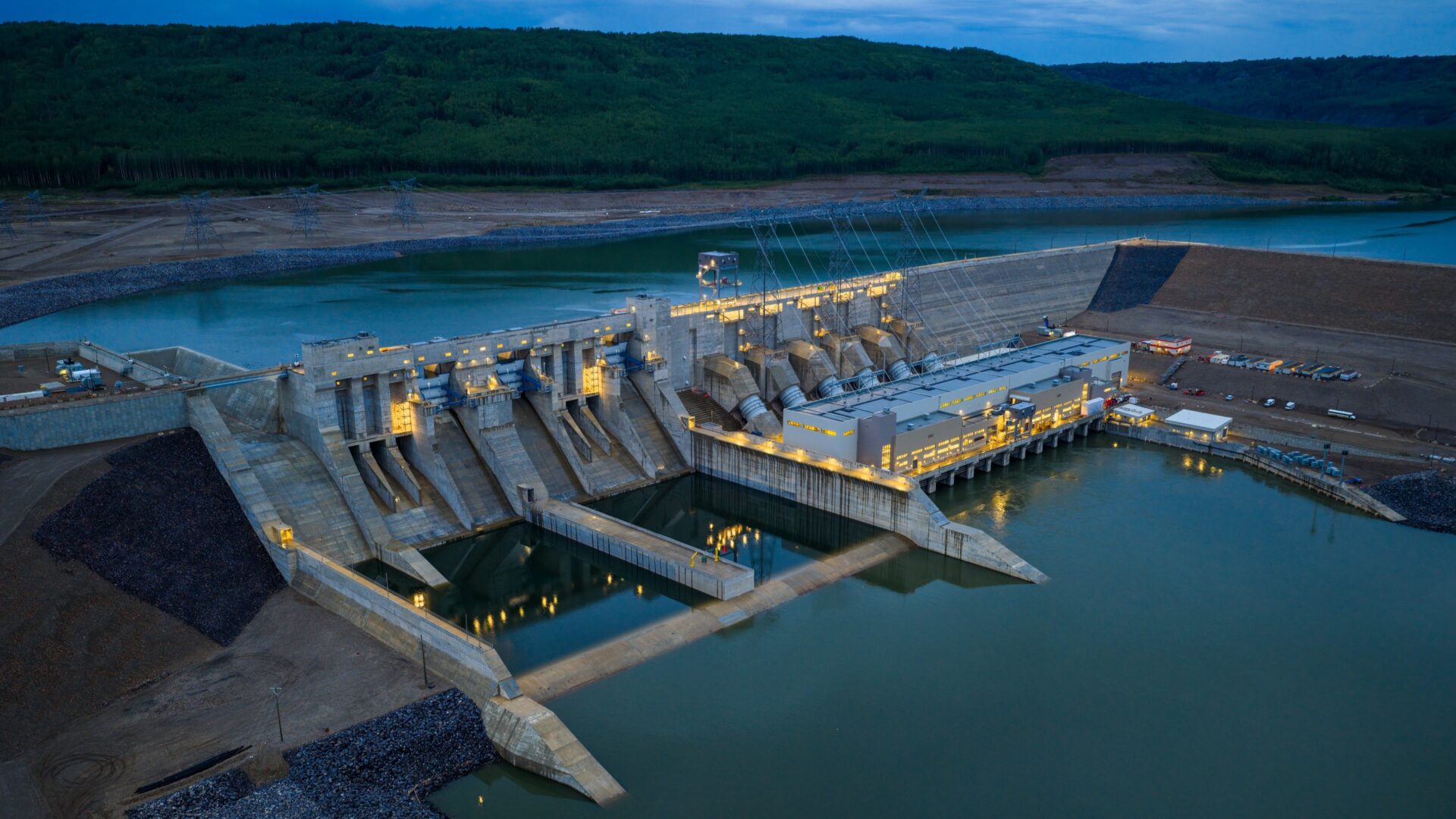
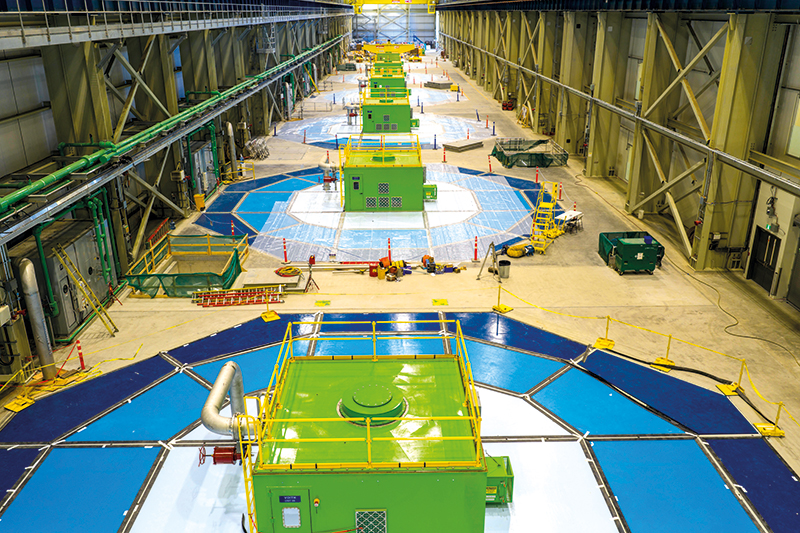
Its six generating units began coming online domino-style a year ago when Site C’s 10,000-hectare reservoir reached a maximum depth of 52 metres. Together, the units can harness the kinetic power of water to produce between 1,100 and 1,230 MW of hydroelectricity at any given time.
That works out to a yearly output of 5,100 gigawatts, enough energy to power nearly a half-million homes. It also represents an eight per cent boost to BC Hydro’s 43,000-gigawatt power grid, a high-voltage electricity generating network that includes 33 generating facilities (30 of them hydroelectric), 70 dams, 18,000 kilometres of lines and underwater cables, 100,000 wood poles, 22,000 steel towers and 292 substations, spread out over 75,000 hectares.
Most of the grid’s hydroelectric power is generated in the northern and southern regions of the province, with nearly 60 per cent coming from facilities on the Columbia River and 35 per cent from power stations on the Peace River, which boasts B.C.’s largest generating station, the W.A.C. Bennett Dam, and now Site C (third largest). Eighty per cent of all that energy is consumed in the dense urban areas of the Lower Mainland and Vancouver Island.
“The commission of Site C’s final generating unit is another step forward to securing B.C.’s clean energy future,” Adrian Dix, BC’s minister of energy and climate solutions, said in a press release in the days following the CNO signing. “I extend my sincere appreciation to the thousands of people who worked on Site C over the past decade—because of your work, generations of British Columbians will benefit from reliable and affordable clean electricity.”
For her part, BC Hydro president and CEO Charlotte Mitha said the project “represents years of dedication, innovation, collaboration and overcoming challenges. Now that Site C is in full operation, it will serve our customers for the next 100 years and play a critical role in ensuring a stable and reliable electricity system.”
(BC Hydro)
By any measure, the Site C Clean Energy project was a colossal undertaking for owner BC Hydro, which managed and administrated the project from A-Z. And as project leader and the professional responsible for the planning, coordination, execution and monitoring of the work that was done over the entire Site C dam and reservoir site, Waite has carried a particularly heavy burden throughout the life of the massive construction project.
It was a challenge, however, that he both welcomed and was prepared for. Born and raised in Ontario, Waite moved to Vancouver Island 30 years ago after graduating with a forestry degree from Lakehead University. “[B.C. was] where the big trees were,” he said.
He notably spent several years working for Canadian forestry giant MacMillan Bloedel, then the world’s largest producer of softwood lumber, helping to design and develop roads and other infrastructure needed to locate, harvest and haul logs to mill.
“I developed an interest and expertise in project management, then project life cycle” said Waite, who has a PMP certification.
He signed on with BC Hydro as a project manager in 2007. Six years later he was tapped to help plan the construction and project management of Site C, a project that had been decades in the making and was one of several sites identified as potential hydro electric generating sites.
Given the green light by B.C. Premier Gordon Campbell’s Liberal government in 2010, at an initial estimated cost of up to $6.6 billion, Site C faced fierce opposition and legal challenges from various groups, individuals and politicians.
A joint review panel also questioned the need, cost and impacts of the project and recommended in 2014 that an economic assessment of Site C be carried out by the BC Utilities Commission.
The Liberal government of B.C. Premier Christy Clark ignored those concerns and gave the project the green light in a Final Investment Decision in Dec. 2014.
Though involved with the Site C project during its regulatory phase, Waite was transferred to Revelstoke 6, another hydroelectric project that aimed to add a sixth generating unit to the Revelstoke Generating Station on the Columbia River.
When the 500-MW project was deferred (though it was later revived and received environmental approval in 2025, with construction set to begin in 2026), Waite returned to Site C to help plan the implementation phase and get the project rolling.
Early work on the site included the building of an accommodation camp for up to 2,000 workers—from tradesmen and heavy civil truckers to excavation operators, engineers and labourers—and the building of 14 kilometres of construction roads and a bridge over the Peace River.
“We also did early excavation work on the site, including taking material off the left bank to help flatten slopes on the dam,” said Waite.
Named director of off-dam site work of Site C in Aug. 2018, Waite oversaw a myriad of other project building requirements, including the realignment of 32 kilometres of paved roads on Highway 29, an existing provincial highway that connects the towns of Hudson’s Hope and Fort St John, 14 kilometres northeast of the proposed dam site.
He also supervised the construction of two new 75-kilometre-long, 500-kV transmission lines that now connect Site C’s facilities to the Peace Canyon Substation, and the cutting and clearing of thousands of trees and other materials from what would become the Site C reservoir.
“We did many geotechnical studies and work on the eight-kilometre-long reservoir site, which was forested with the Peace River flowing through it,” said Waite. “[And] we had to clear the forested area of the dam site, construct access roads, and begin relocation of millions of cubic metres of material on the site to prepare for construction.”
When he was promoted to construction director of Site C in the early winter of 2020—just weeks before the global COVID pandemic hit—Waite was suddenly faced with the additional challenge of keeping the project moving forward despite all the public health fears and restrictions that arose and lasted for more than a year.
He credits the fact that all project resources were at that point focussed on the building of two concrete line tunnels through which the Peace River could be diverted for reducing the risk of COVID infections.
“That helped keep the camp population down to 600 or 700 people,” said Waite. “(And) we had isolation dorms for people who tested positive plus changing practices, masks, health clinics on site that gave vaccines and we worked closely with regional health authorities. We were able to get through it.”
The Site C project reached its first major construction milestone in Oct. 2020 when the Peace River was diverted through the two concrete lined tunnels. “Then we could start construction of the coffer dam,” said Waite.
Once that work was completed in the spring of 2021, work began on building Site C’s earthfill dam. It took two years to build the massive dam, which contains more than 15 million cubic metres of material and measures more than 1,000 metres long, 500 metres wide at its base and 60 metres high above the riverbed. It also required the relocation of 11 million cubic metres of material off the bank above the dam.
The site’s generating station with its six 183 MW Francis turbines was also built over 11 months at this stage of the project. In addition, an 800-metre, roller-compacted concrete buttress to enhance seismic protection of the spillways, generating station and the dam abutment.
Work on that structure began in 2017, with crews placing a total of 1.68 million cubic metres of roller-compacted concrete in three large buttresses or foundations. “Those are big volumes,” said Waite. “For us (Site C) is a medium-sized facility, like Revelstoke. The spillway though is the largest in our fleet.”
Another major milestone was reached in early Aug. 25, 2024, when the reservoir began filling. “By then all the major infrastructure was in place and ready to go,” said Waite. “At that point there’s no turning back. You must be confident in the work you’ve done.”
It took 11 weeks for the reservoir, which extends from Fort St. John to Hudson’s Hope, to reach its full water level over its surface area of 93 square kilometres.
“As the reservoir filled, we started passing water first through the spillway and then thru the penstock for unit one as we started commissioning,” said Waite.
The official coming online of unit No. 1 was celebrated with snacks, speeches and the usual hoopla at a reception for a few hundred workers and VIPs in the Site C powerhouse at 10 a.m. on Oct. 27.
“After first power the remaining units came online as the reservoir continued to fill,” said Waite. “With the gates in place we could seal off each generating unit and let water into each of them, one at a time.”
Though his official signing of the NCO for the No. 6 generating unit was subdued, Waite said the event was celebrated with two larger events a few weeks later: one for workers at the site camp; another for BC Hydro brass and Site C project office team members in a restaurant near BC Hydro headquarters in downtown Vancouver.
“It was a good opportunity for the team to get together,” said Waite, who led a team of roughly 250 BC Hydro employees on site during the project, plus another 250 in Vancouver and an equal number of in-house consultants.
He said that at the peak of construction work in June 2023, Site C had 2,400 contract workers on site, 20 per cent of them locals. The project also employed up to 540 Indigenous people.
“We went 24/7 throughout the life of the project,” said Waite. “It was a very demanding job with long days and often meetings and calls on nights and weekends. The only time things slowed down was a few days around Christmas.
“Everything was based on the pace of construction, the challenges we faced and always keeping people safe,” he said. “You never knew what would happen next.”
Waite recounted one of many incidents that arose requiring a quick and thoughtful response to avoid delays and knock-on effects downstream—or worse.
“I remember one day getting a call that a large concrete placement had failed the quality check,” he said. “It turned out that fly ash instead of cement had been added to one of the concrete pours. It was in a critical location and had to be removed. It took several months to carefully chip out and remove before it could be replaced and work in that area could continue.”
He said BC Hydro’s strong safety culture—one that spells out the public utility’s expectations of contractors and are written into its contracts—helped to avoid any fatalities or serious injuries in the 66 million hours of work done during the construction of Site C.
“We were always looking to try and stay ahead of things,” said Waite, who has lived in Fort St. John since taking over as Site C project manager in 2020. “We identify issues and follow processes. We investigate and learn as we go.”
He said he intends to remain in Fort St. John, an old trading post on the Alaska Highway that has grown into a town of 22,000 on the western edge of the Canadian Prairies, until 2026 when finishing work at Site C is expected to end.
“Now we’re backfilling and putting concrete plugs in the concrete lined tunnels and putting them to bed,” said Waite. “We’re also paving roads and parking lots, doing reclamation work and reforesting some areas.”
Other remaining tasks include removal of the workers’ accommodation camp, final commissioning of all mechanical and electrical systems, repairing and/or completing any identified deficiencies, and fully transitioning the facility to BC Hydro’s operations teams.
“I’ve enjoyed living here in this really welcoming community,” said Waite. “And I get to witness the many positive impacts this project has had and will have on this region for a long time to come.”
Mark Cardwell is a freelance writer based in the Quebec City region.
[This article appeared in the January/February 2026 issue of ReNew Canada.]
Featured image: (BC Hydro)