
The nuclear energy landscape is undergoing a massive, era-defining pivot, and Canada is positioning itself at the absolute forefront of global execution. Far from the old tropes of over-budget and delayed infrastructure mega-projects, the modern nuclear sector is proving that immense complexity can be handled with predictable, on-time, and under-budget delivery.
At a recent panel: Inside Canada’s $100B Nuclear Renaissance, hosted live at the SiteSummit in Toronto, a panel featuring project leaders from Ontario’s nuclear industry, gathered to break down the mechanics of this operational turnaround. The consensus was clear: successful execution is entirely a product of integrated delivery models, rigorous workforce training, and an unwavering commitment to cultural alignment.
Shifting From “Owner vs. Vendor” to One Team

The jewel in the crown of Canada’s nuclear footprint is the recently completed $12.8-billion Darlington Refurbishment project. Navigating a massive project like this required an aggressive overhaul of historic structural barriers. Sarah Elliot, Project Director at Ontario Power Generation (OPG), recalled that the culture in the sector’s early days looked fundamentally different from today’s tightly aligned ecosystem.
“One of the shifts was definitely our one team approach,” Elliot explained. “This is our kind of integrated view of the project with our vendor partners, so it really transitioned from an owner versus vendor to a one team attack problems together. It doesn’t matter what company you’re with; it just matters on leaning in and helping each other solve the problem.”
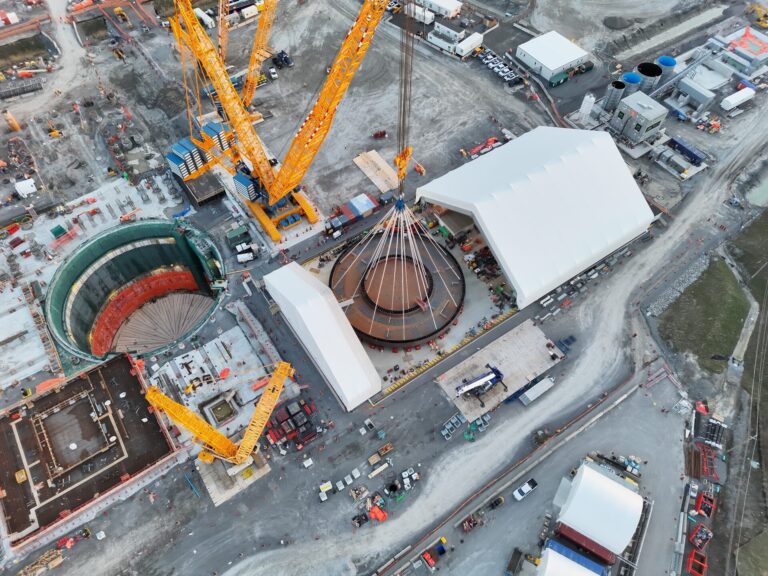
This cultural blueprint was reinforced by physical co-location, ensuring that engineers, managers, and contractors worked side-by-side. “Being together and not on conference calls where, you know, Wi-Fi can drop and you can close your laptop and the problem goes away—it’s you’re there together,” Elliot noted. This collaborative foundation allowed project teams to seamlessly transfer massive repositories of programmatic insights into future builds. OPG tracked roughly 8,000 distinct lessons learned during the refurbishment, embedding them directly into current readiness reviews for the Darlington New Nuclear Project (DNNP), which will see the construction of the G7’s first Small Modular Reactor (SMR).

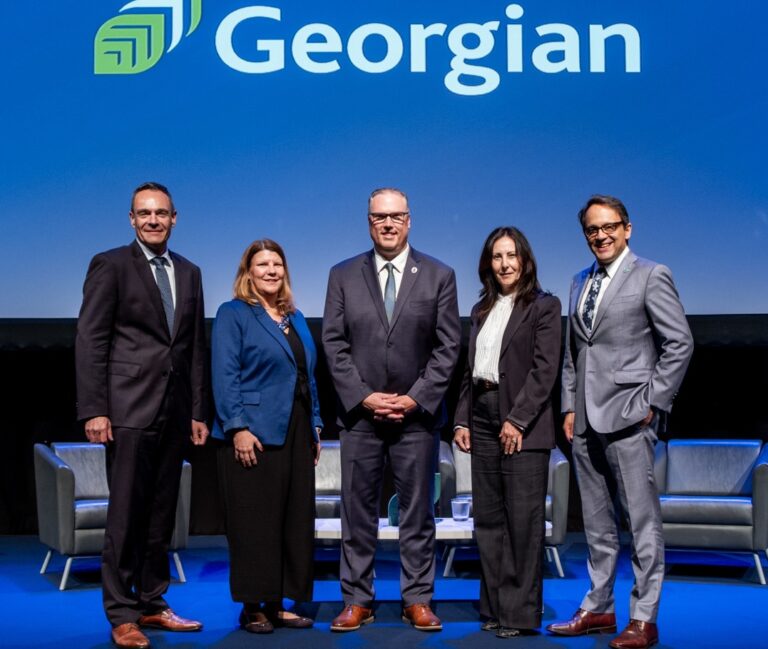
(L to R): John Tenpenny, Editor, ReNew Canada; Sarah Elliot, OPG; Mark Philpotts-Delisser, Aecon; and David Leclerc, Aecon. (SiteMedia)
Rehearsing the Ballet: Field-Level Innovations
When executing field operations under rigid safety margins, builders must optimize every physical sequence to the second. To accelerate timelines on Darlington’s Unit 4 without compromising quality, Aecon relied extensively on heavy-duty mock-ups to systematically test tasks before launching them in live vaults.
Mark Philpotts-Delisser, deputy construction director with Aecon, described these intensive trial sequences as vital to maximizing efficiency and dose management.
“Time trials are really important,” Philpotts-Delisser emphasized. “Like I said, you’re almost rehearsing a ballet when you’re doing this work, and it’s people like the fact in the neighborhood that everybody is trained properly, they learn, and they can do this work efficiently.”
This field-level perfection was driven by continuous process adjustments, ranging from specialized tool kitting to implementing motorized drives to remove ergonomic strain from the reactor face. By utilizing continuous observation methods—or “waste walks”—the field crews stripped unnecessary transit time and friction out of every operational shift.
Overcoming Bottlenecks and Commercial Friction
A project spanning an entire decade will inevitably run into complex human resource and technical challenges. According to David Leclerc, senior project manager at Aecon, the key to scaling past initial manufacturing bottlenecks, such as early deficiencies in weld quality, is establishing robust structural loops that continuously feed operational insights back into the trades workforce.
“Unit one is the lesson learned program and maintaining that flow,” Leclerc stated. “That’s a key structural element of having any improving projects unit over unit.”
By pulling workers through intense, multi-month training pipelines, the team cultivated a highly skilled, legacy workforce where personnel safely rose from entry-level positions into critical supervisory roles.
Crucially, the panel highlighted that the ultimate driver of this commercial predictability is the industry’s shift toward Integrated Project Delivery (IPD) contract models. Traditional infrastructure projects are frequently detailed by litigious back-and-forth between clients and contractors. IPD completely realigns those financial incentives.
“The fundamental of what makes this project, especially DNNP work right now, is the IPD essentially,” Leclerc concluded. “We’re not sitting in, ‘Well, you said you said,’ because you’re going to end up in change order management for the entire project. A lot of that friction that comes from that is resolved over; let’s all get to the same place because we’re all in this together to get to that end goal.”
A Model for Global Infrastructure
Canada’s current nuclear build-out is providing a masterclass in modern asset management. By shifting away from isolated silos, building long-term labor pipelines, and leaning into shared-risk contract structures, the country’s energy sector is demonstrating how to successfully deliver complex, clean infrastructure at scale. As the industry moves into grid-scale SMR development, the enduring relationships forged between owners and builders remain the true backbone of the nuclear renaissance.
Featured image: (SiteMedia)