
As northern infrastructure faces record-breaking climate volatility, local governments are finding ways to turn adaptation strategies into permanent, resilient assets
By Geneviève Thouin
Across the country, communities are feeling the push to get ahead of the climate crisis. They understand the stakes, and the momentum to design proactive, resilient adaptation strategies has never been stronger. But even under the most ideal circumstances—operating out of an urban boardroom, supported by an in-house team of technical experts and backed by a robust implementation budget—translating a climate plan from paper to poured concrete is a staggeringly complex undertaking.

Now, imagine attempting that exact same feat when the permafrost beneath your town’s only water treatment facility begins to lose its load-bearing capacity.
In Canada’s northern and remote reaches, public works staff are fighting a multi-faceted crisis. They are not just managing failing assets; they are trying to implement adaptation strategies while navigating extreme geographic isolation, profound institutional capacity limits and a climate that is warming at almost four times the global average.1 It’s a high-stakes environment where a localized structural failure can trigger an immediate, community-wide emergency, and where the people managing the crisis are often personally recovering from the very disasters they are fighting.
Deficit deadlock
The backdrop to this challenge is a massive pan-Canadian municipal infrastructure deficit. Currently, 11 per cent of core public infrastructure is rated in poor or very poor condition, yet this alone represents approximately $237 billion in backlog repair costs.2 This crisis is further complicated by a gap in First Nations infrastructure that the Assembly of First Nations estimates at almost $350 billion.3 These staggering figures represent the massive financial gulf between the aging foundations communities currently rely on—like roads, water treatment plants and energy grids—and the capital required to fully repair and climate-modernize them before they fail.
While this national deficit places pressure on every region, navigating it is especially challenging for remote northern communities. Unlike urban centres that can draw upon dense populations and thriving commercial districts to generate property tax revenue, remote communities operate with a highly constrained local tax base. When the terrain shifts or a storm wipes out a critical road, these municipalities cannot simply raise local revenues to absorb what’s known as the northern multiplier—the logistical reality that shortened building seasons, remote transport and specialized engineering inflate baseline construction costs by double to two-and-a-half times4 compared to southern equivalents.
Compounding this is a critical gap in institutional capacity. Maintaining in-house teams capable of managing climate risk modeling and geotechnical assessments and procurement is a financial impossibility for stretched local departments. The bottleneck is rarely a lack of local resolve; it is a lack of accessible capital that aligns with the realities of remote, site-specific infrastructure projects.5
Further, national infrastructure frameworks of the past imposed rigid, top-down targets that ignored geographic realities, forcing small teams to exhaust limited resources on administrative metrics rather than on-the-ground asset protection. When local staff is dividing their time between paperwork and the day-to-day realities of their job, compliance fatigue sets in—all the while, real-world risks and end-of-life infrastructure woes continue to mount. The financial consequences of these administrative delays are measurable and severe: While a 2024 report6 by the Insurance Bureau of Canada noted that insured damages from extreme weather in Canada hit a record high of $8.5 billion, a recent 2025 update revised that figure to $9.4 billion.7
Geological instability
Nowhere is this crisis more literal than in the ground itself. Across the 50 per cent of Canada underlaid by permafrost, the terrain is increasingly unstable.8 This causes more than just headaches for locals; it invalidates historical infrastructure lifecycles, causing premature depreciation through foundation buckling, pipeline shear or runway failures.
The Canadian Climate Institute’s Due North report puts a considerable economic value on this geological shift, calculating the annual costs of permafrost damage to Yukon’s road network at $73 to $85 million9 a year without incremental adaptation measures in place.
Northern infrastructure failures can trigger cascading operational crises. In Iqaluit, a documented shift in ground conditions compromised the foundation of the city’s main fuel storage tank,10 threatening the entire community’s water, sanitation and healthcare delivery systems. Simultaneously, changing weather patterns are eroding critical supply chains. Shortened winter seasons means late freezing and early thaw for ice-roads.11 And for fly-in communities, the transition away from commercial jets certified for gravel runways12 has restricted cargo volumes, while climate volatility is narrowing the operational window for winter road construction, forcing a costly reliance on air freight.13
Bridging the gap: Operationalizing resilience
Managing this risk requires a fundamental shift towards proactive asset management rather than reactive repair. Local governments are evaluating how climate change actively shortens the lifecycle of core community assets. However, making this shift work under tight capital budgets requires drawing a line between long-term structural protection and short-term crisis management.
When adaptation is integrated into early asset planning, the economic case becomes undeniable. A 2019 World Bank analysis14 notes that the incremental cost of making public infrastructure resilient can be as low as three per cent of construction expenses if integrated during the early design phase. Over the life cycle of an asset, that minor upfront capital investment yields immense dividends. Data published by the Canadian Climate Institute in 2022 indicates that every dollar invested in proactive adaptation can save up to $15 in future economy-wide costs.15 Spacing out these variables allows local rightsholders and engineering teams to plan for real-world cost avoidance rather than constantly rebuilding failing infrastructure.
This is the operational friction the Green Municipal Fund is working to help resolve through its Local Leadership for Climate Adaptation (LLCA) initiative. Funded by the Government of Canada, LLCA is deploying $530 million to accelerate and scale local, data-informed climate adaptation.
To bridge the capacity gap, LLCA offers training, hands-on coaching, peer learning and practical resources to help local governments develop the skills required to lead local adaptation efforts. Crucially, LLCA’s highly agile approach to financing ensures support is scaled to the current climate journey of each community:
Climate-Ready Plans and Processes: For municipalities in the early stages, this funding provides up to $140,000 to conduct site-specific hazard assessments and integrate climate resilience into existing asset management and procurement workflows. This provides the necessary resources to begin building a reliable roadmap without draining local operational budgets.
Adaptation in Action: For communities ready to move into the construction phase, this funding provides up to $1 million to implement climate adaptation projects that reduce risks, protect public infrastructure and deliver nature-positive solutions. It also offers up to $70,000 to assess project viability and cost-effectiveness before moving to construction. Additionally, its Rapid Adaptation Projects offer provides up to $75,000 for small communities to implement immediate, high-impact solutions.
The path from a climate strategy to poured concrete is complex, but it doesn’t have to be a solitary endeavour for remote communities. By aligning the right financial tools with the specific needs of local teams, initiatives like LLCA are actively dismantling the systemic barriers that have long sidelined the North. When we empower local governments to transform data into defensive infrastructure, we strengthen the long-term resilience of Canada’s most vital and vulnerable communities.
PROJECT SPOTLIGHT: NISUTLIN DRIVE DIKE, VILLAGE OF TESLIN, YUKON
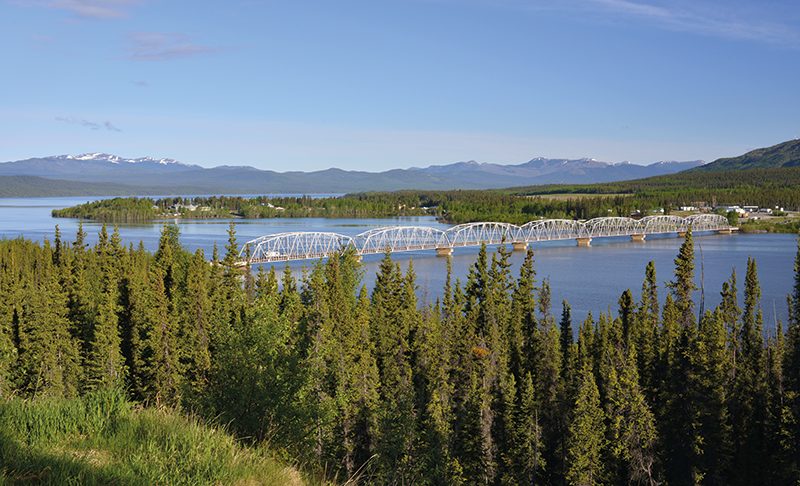
For the Village of Teslin, Yukon, adapting to climate change is a proactive choice driven by the real-world impacts of extreme weather events on the community’s 450 residents. Following two consecutive years of catastrophic flooding along Teslin Lake, local leadership moved to address the vulnerability and anxiety that had come to define the spring thaw. The municipality identified that these events created a critical risk, namely high lake levels could lead to the potential failure of water and sewer systems, triggering a mass evacuation.
To protect community infrastructure and residential areas, the Village of Teslin utilized a grant from the Green Municipal Fund’s Local Leadership for Climate Adaptation initiative. This funding was directed towards the construction of a 150-metre armoured dike along a segment of the Nisutlin Drive shoreline.
Designed to withstand 0.5% Annual Exceedance Probability (AEP) lake levels, including wave action, the dike also connects with and complements previous flood protection work completed along Jackson Avenue in 2024 to create a continuous protection system. Further, its implementation directly protects five critical public buildings, ensuring the continuity of essential services for the community.
“When high water threatens critical assets and community safety, you must act. Connecting this new dike to our existing infrastructure means Teslin residents can breathe a sigh of relief, allowing us to shift our focus and plan for resilience efforts that meet the climate realities our community is facing.” —Shelley Hassard, CAO, Village of Teslin
The construction utilized a hybrid engineering design. The core of the dike was built using engineered rip-rap, filter fabric and crushed rock, while a culvert was integrated to maintain drainage and prevent ponding. Additionally, the project incorporated natural infrastructure along the toe of the dike to reduce long-term maintenance. During the fall dormancy period in October 2025, 150 live stakes of native willow and balsam poplar cut from local stock were planted to provide ongoing erosion control, bank stability and habitat enhancement.
Administratively, the project was executed through an Indigenous partnership model. The Village of Teslin and the Teslin Tlingit Council shared oversight and governance. Implementation involved weekly meetings with the Teslin Tlingit Council, the Village of Teslin, the Yukon Government, consultants and the project superintendent.
Now completed, the dike has successfully resulted in lower anxiety among community members, demonstrating the immediate link between structural resilience and community well-being.
Geneviève Thouin is is the Director of Adaptation Programs at the Green Municipal Fund.
[This article appeared in the November/December 2026 issue of ReNew Canada.]
Featured image: (Getty Images)