
By Ashish Jain and Michelle Throssell
2025 marked a year of transition for Canada’s economy and construction sector following a step-change in international trade policy and further retrenchment from globalization. Economic growth has resultantly softened, giving way to an uneven recovery, and while conditions have begun to stabilize, progress is not uniform.
Public programs and infrastructure pipelines have anchored activity while private investment remains selective. Yet persistent input cost pressures and productivity challenges continue to shape delivery and financing constraints have kept many projects on the sidelines.

By analysing and evaluating relevant data, what can clients learn about the construction industry? How can they move from reactive coping to proactive delivery, and how do they secure certainty in a market that is stabilizing, but still far from predictable?
All bets on infrastructure
Canada’s economy faced notable uncertainty and significant tariff headwinds in 2025 yet remained resolute. At the time of writing, Gross Domestic Product (GDP) is expected to increase by 1.7 per cent, with the Bank of Canada forecasting a modest expansion of 1.1 per cent in 2026.
And while construction GDP advanced by 2.6 per cent on the year in Q3 2025, this belies the challenges the industry has faced. Persistent cost pressures, tempered confidence and liquidity constraints have all contributed to a subdued and increasingly polarised construction industry.
Sluggish private sector investment has been a hallmark of 2025, with increasing geopolitical tension and growing trade barriers negatively affecting investment decisions—most notably in the residential market.
The RPS House Price Index fell for its fifth consecutive month in November 2025 and residential building permits contracted by 8.5 per cent on the year in Q3 2025. Pre-sales are also subdued, foreshadowing a difficult start to 2026.
Industrial investment in building construction is also suffering, falling by six per cent on the quarter in Q3 2025. Part of this vulnerability is linked to overbuilding in 2024, but trade-related uncertainty has also taken its toll on growth.
Public spending, however, is anchoring construction activity as infrastructure investment and defence spending support immediate growth and boost long-term productivity. Civil engineering GDP jumped 4.4 per cent on the quarter in Q3 2025, hot on the heels of Bill C-5 gaining Royal Assent. This outsized gain accounts for the bulk of the recent industry GDP improvement.
Alongside the Major Projects Office (MPO), and Bill C-15’s scope to build one Canadian economy, targeted investment in infrastructure will bolster growth by reducing red tape and accelerating approvals. Institutional and governmental investment in building construction continues to strengthen as well, with growth unbroken since Q3 2023.
Despite overall workloads currently being suppressed, there is scope to see recovery as 2026 unfolds. As such, it is important to delve deeper into the detail of recent inflationary trends and evaluate longer-term supply and demand dynamics which could influence construction cost escalation for the years ahead.
Progressive inflation
After an uptick following the imposition of tariffs by the United States, and countermeasure tariffs by the Canadian government, inflation alleviated toward the end of 2025. Both October and November saw the Consumer Price Index (CPI) decelerate to 2.2 per cent—0.2 percentage points above the Bank of Canada’s target of two per cent.
In construction, materials cost growth has been more bullish. As of November 2025, a weighted basket of materials and components tracked by Turner & Townsend increased by 3.4 per cent on the year.
Beneath the surface, movement is more pronounced. Over the same period, copper pipe and tube and copper cable increased by 14.6 and 5.2 per cent, respectively. This spike was driven by strong demand from mechanical and electrical trades, constrained global supply and US import tariffs that have tightened availability and pushed up costs.
Concrete paving, masonry units and ready-mixed concrete climbed by 8.0, 7.8 and 7.6 per cent, respectively, owing to growing infrastructure workloads, raw material cost increases and notable transportation expenses.
Structural steel only increased by 1.2 per cent and steel pipe and tubes fell by 15.3 per cent, with tariff-linked cost pressures more prominent in the U.S. than Canada. However, tightening Canadian steel import duties will see reduced quotas and an additional surtax that will likely increase costs. Knock-on effects will also be notable, with lead-in times lengthening, heightened compliance risks and more onerous administrative requirements.
Labour conditions continue to shape deliverability as well. The unemployment rate in construction has steadily increased from 4.3 per cent in Q3 2022 to 6.4 per cent in Q3 2025 as contractor orderbooks weakened. Apprehension has also filtered through into hiring decisions, with vacancies dropping to 3.0 percent in Q3 2025—their lowest value since Q3 2017.
All of which have contributed to the reduced availability of construction workers. As a result, labour costs have continued their steady upward trajectory, with average weekly earnings rising by 5.9 per cent on the year in Q3 2025. This growth is now underpinned by newly ratified union wage agreements across multiple provinces, which will lock in annual increases for several years.
Construction productivity also remains muted, having fallen by 8.1 per cent since the pandemic. Retirements outpacing recruitment, skill gaps and slower adoption of technology continue to constrain efficiency, compressing margins and adding complexity to schedules.
The impact of Bill C-5, C-15 and the MPO on the labour force should not be discounted, though. The federal government, led by Prime Minister Mark Carney, plans to expand skilled trades training programs to help industry supply meet demand. However, if several new projects are greenlit concurrently and development quickens simultaneously, significant strain would be placed on the labour market, as the construction industry is unlikely to scale up quickly to match rapidly increasing workloads.
Taking a comprehensive view on construction cost escalation can help the sector strategize. These are representative of Canada as a whole—and the national figures do not depict provincial vagaries or project-by-project specifics. The forecast is based on our prediction of national bid price escalation, compiled from proprietary data, market research and practitioner expertise.
Rather than focusing just on input costs—these figures account for market conditions, commercial pressures and other indirect factors. At the time of writing, Turner & Townsend estimates bid price escalation between 1.5 and 2.5 per cent for 2026, as subdued GDP and reduced project activity constrain industry price pressure. This is higher than the one to two per cent seen in 2025.
Lagged fiscal stimulus and federal investment should see escalation proformas pick up to between 4.0 and 5.0 per cent in 2027, alongside a release of private sector pent-up demand. National infrastructure projects and programs could also accelerate skill shortages and worsen supply chain bottlenecks, applying a premium on strained resources.
Collaboration is key
With workloads set to firm up towards the latter half of 2026, and into 2027, escalation pressures are likely to grow. Alongside persistent volatility, the infrastructure segment of construction will be exposed to continually shifting market forces and recalibrating supply chains.
A proactive and multi-pronged approach to planning, procuring and delivering of infrastructure projects is needed to manage these risks and capitalize on benefits for the long-term successful implementation of these schemes across the country.
With data indicating future pressures on resource availability, the time is now for companies and organizations to invest in talent development locally to meet the growing need to deliver the expanding list of multi-billion-dollar, multi-year projects that will be delivered in the coming years.
The volatility in some areas of the construction market is making it more complex and challenging for clients and contractors to deliver high quality, on-time and on-budget outcomes. While a clear preference has been shown in recent years to move toward more collaborative contracts, specifically Progressive Design-Build (PDB), Alliance or Target Cost, this change needs to be done based on project-specific parameters and market sounding, and not as a one size fits all solution. In addition, implementing these contracts is the first step, but truly internalizing the collaboration required and delivering the works in the true spirit of the contract is the key for long-term success.
A specific benefit of these collaborative contracts which must be successfully leveraged during these uncertain times is risk allocation and management which should be balanced between parties and reflect a best for project strategy. While the initial evaluation of risk and an honest division of which entity is best placed to manage it is critical, meaningful management of existing and emerging risks throughout the project life cycle is equally as important.
Finally, during these changing times, organizations need to leverage the available data, from project sources, organization and the wider market, to identify cost and capacity issues early for the best opportunity to effectively manage the impact.
While 2025 forced us to face unexpected volatility, it also strengthened our national resilience to meet the challenge and deliver “made in Canada” solutions that develop our resources and deliver exciting and complex projects for the benefit of the nation.
Ashish Jain is the Managing Director, Canada, at Turner & Townsend.
Michelle Throssell is the Director and Head of Infrastructure, Canada at Turner & Townsend.
[This article appeared in the March/April 2026 issue of ReNew Canada.]
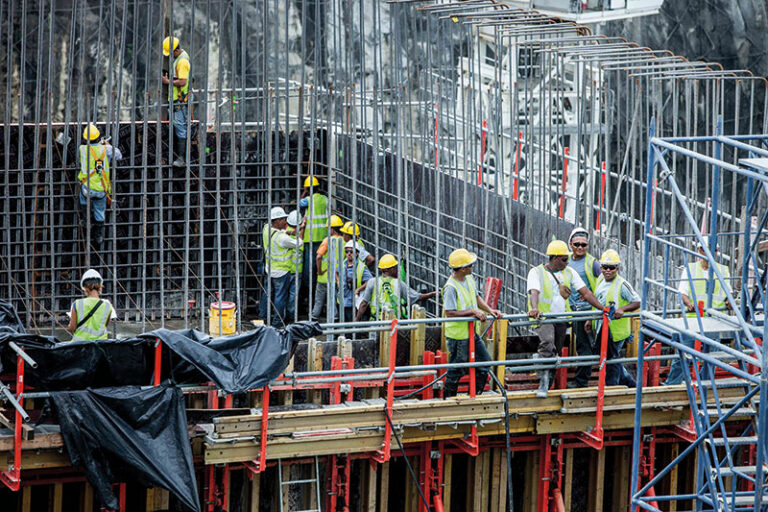
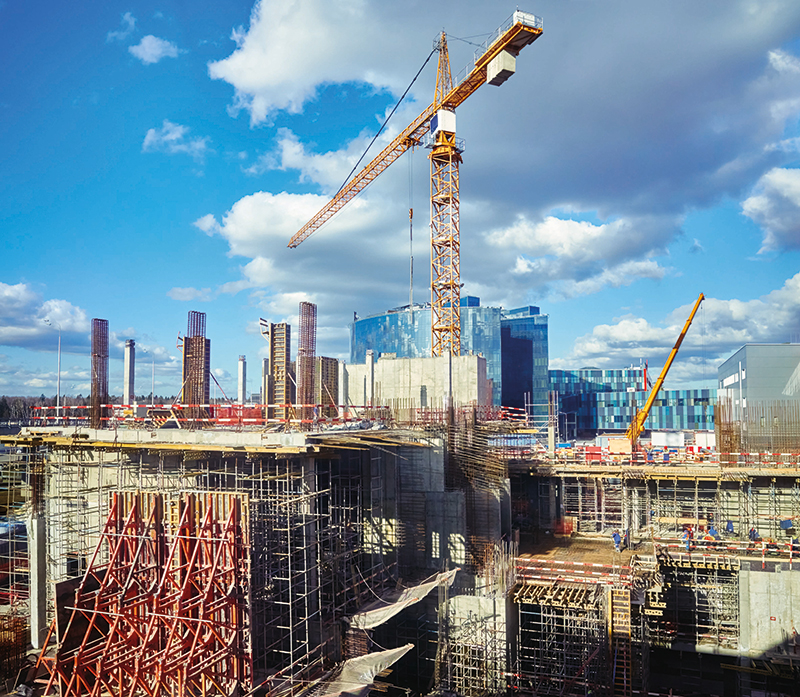
Featured image: Persistent input cost pressures and productivity challenges continue to shape delivery and financing constraints have kept many projects on the sidelines. (Getty Images)