
Wastewater infrastructure is the invisible backbone of a healthy society, but the challenges of maintaining and expanding these systems have never been more complex. From navigating rigid regulatory environments to addressing the existential threat of sea-level rise, the industry is moving toward a more integrated, tech-forward approach.
That was the central theme of a recent webinar hosted by Renew Canada and Water Canada, sponsored by PCL Construction. A panel of experts explored how innovation, resilience, and early collaboration are reshaping the way we build the facilities that protect our most precious resource.
The power of early contractor involvement
The traditional “design-bid-build” model is increasingly being viewed as a hurdle to efficiency. Ian McKinnon, manager of civil operations for PCL Edmonton, emphasized that bringing constructors to the table before the design is finalized is no longer just a luxury—it is a necessity for risk mitigation.
“Early input really helps us flag constructability issues and optimize the sequence of construction long before design is locked in, and that helps obviously reduce change orders, RFIs, and the worst cases, delays,” McKinnon explained. “Anything that takes away from the focus of the task at hand… is a detriment to what people are supposed to be doing each day. Minimizing late changes just should be a key goal for every project.”
From the owner’s perspective, Kate Polkovsky, CEO of ARROW Utilities, noted that early contractor involvement is a significant driver of cost certainty. “The contractors have such a good lens on what is reasonable to construct, what will cost an additional few hundred thousand dollars just by bending rebar and taking additional time,” she said. “You also have the opportunity of getting some long-lead items ordered much earlier, which can help with your timelines of your project as well as mitigating further inflationary impacts.”
Lucy Cotter, project manager for the Iona Island Wastewater Treatment Plant Projects for Metro Vancouver, agreed, noting that designers often miss the practical field perspectives that a contractor provides. “We’re really looking for that different perspective,” Cotter said. “The things that design engineers maybe are not thinking about… can save on schedule and budget.”
Digital twins and the “video games”
The adoption of Building Information Modeling (BIM) and Digital Twins is transforming both the construction phase and the eventual handover to operations. McKinnon highlighted a project for ARROW Utilities where a full digital model was instrumental in pre-planning.
“We used the model extensively for phase planning and sequencing,” McKinnon said. “By flipping a few sequences around, we managed to do a few things like minimize shrinkage on the concrete, really ensure that our openings that were left for say mechanical installations and whatnot were optimized.”
For Polkovsky, the value of a Digital Twin extends far beyond the ribbon-cutting ceremony. She views it as a critical training tool for the next generation of operators. “It’s the training aspect,” she noted. “Having people play with the system that’s not really functioning, but they can see where things start to break… they can really start sort of playing that ‘video game’ and understanding what happens when we over-aerate or when we under-aerate and how we save costs versus energy.”
However, the panel cautioned that technology is only as good as the people using it. “The digital twin’s not the answer that saves all the dollars,” Polkovsky warned. “You still need that really involved project team that is looking at that lens from the value engineering side of things to look at where we can save, where we can spend.”
Navigating regulatory and logistical hurdles
Building wastewater plants often involves working in environmentally sensitive areas or remote locations. This requires a level of transparency and “owning” the data that many owners are still getting used to.
“I think it’s really about owning the information you know, and then also identifying what you don’t know,” Polkovsky said regarding site conditions like high groundwater or contaminated soils. She also noted the difficulty of permitting when using collaborative models. “They are not getting 100 per cent drawings when we start that permitting process. There was a big education with our regulatory bodies of them understanding why when we have this first conversation, we’re looking at 30 per cent drawings.”
In British Columbia, Metro Vancouver manages these complexities through long-term planning. “We have an overall permitting plan,” Cotter explained. “We kind of map out for the next 20 years what our permitting requirements are and just staying on top of changes as we go.”
McKinnon added that technology can help bridge the communication gap with regulators. “We have various programs… that are helpful in demonstrating our phasing to some of the regulatory agencies,” he said. “They can see well enough that there’s a new river outflow… but they don’t necessarily understand exactly how it’s going to get built. We’re able to demonstrate to them, ‘This is how long we’ll be actively working the river’.”
Climate resilience and adaptation
Perhaps the most pressing issue for modern wastewater infrastructure is the changing climate. For the Iona Island WWTP project, located at the mouth of the Fraser River, the risks are literal and immediate.
“Our site is at risk to sea level rise,” Cotter said. “All of the critical infrastructure will be raised to above a flood construction level. And then for passive flood protection, we’re looking at nature-based shoreline protection, wetland protection, and planting along the shorelines.”
In Alberta, ARROW Utilities is building resiliency into the process itself. “We made an active choice… to go to a membrane treatment (MBR) as opposed to just traditional bioreactor treatment,” Polkovsky explained. “That does provide a level of resiliency of being able to manage influxes or surges of peak flows without washing out your bacteria.”
McKinnon noted that PCL is often brought in to retroactively protect legacy facilities. “We’ve been employed on a couple projects, not just installing berms… but installing gates on things like storm outlets and outfalls and pipes, because really we want to also avoid inflow and flooding through the plant.”
The circular economy
The future of wastewater is not just about treatment, but resource recovery. The panel discussed the growing trend of integrating biosolids and biogas into facility design.
“Metro Vancouver has multiple facilities with RNG, so taking the biogas off the digesters and then either using it for heating or electricity generation on sites or upgrading it to sell back to Fortis in BC,” Cotter said. “We’re also looking at piloting ammonia and hydrogen recovery.”
Cotter also highlighted a cutting-edge pilot project: “Metro Vancouver are piloting hydrothermal liquefaction as a potential treatment for biosolids. That is pretty exciting in the world of wastewater to take sludge and making a bio crude product from that.”
Future growth
Planning for the next 50 to 100 years requires a balance between ambition and fiscal responsibility. Overbuilding is a waste of taxpayer dollars, while underbuilding leads to expensive emergency expansions.
“We’ve also looking to implement a modular design so we can build out in response to reality rather than overbuilding or under-building,” Cotter said of Metro Vancouver’s strategy.
McKinnon noted that contractors play a vital role in these lifecycle discussions. “Part of our role for sure is to help advise the owners and the engineers, ‘What is the cost to upsize a pump room?’” he said. “Everyone knows it’s much, much more expensive to expand a building than just simply put the pumps and piping in… we’re trying to forecast future costs and look at as well lifecycle costs for those things with the owners all the time.”
Building relationships
The panel concluded that while technology and engineering are the tools, relationships are the foundation of a successful project. Polkovsky used a colorful analogy to describe the evolution of a collaborative project team.
“I have described our project as it was rainbows and butterflies to a point and we were in this newlywed experience and then we hit that crossroads that we were either going to stay married or get divorced,” she laughed. “They had to go through that relationship-building process… to build that comfort… and it has been generally smooth sailing since then.”
As Canada continues to modernize its wastewater systems, the move toward early contractor involvement, digital modeling, and climate-conscious design appears not just as a trend, but as a survival strategy for the 21st century.
[This article appeared in the March/April 2026 issue of ReNew Canada.]
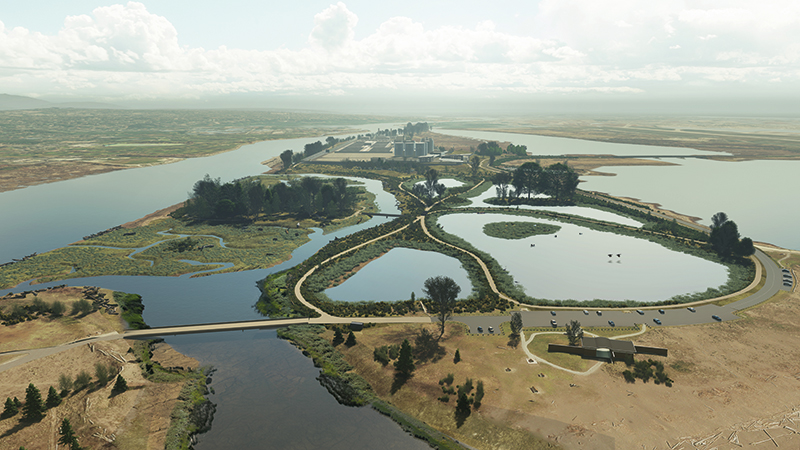
Featured image: Rather than building an entirely new facility, Metro Vancouver will rehabilitate the existing Iona Island primary treatment plant and deliver phased upgrades to achieve compliance for secondary wastewater treatment. (Metro Vancouver)