
By David McPherson
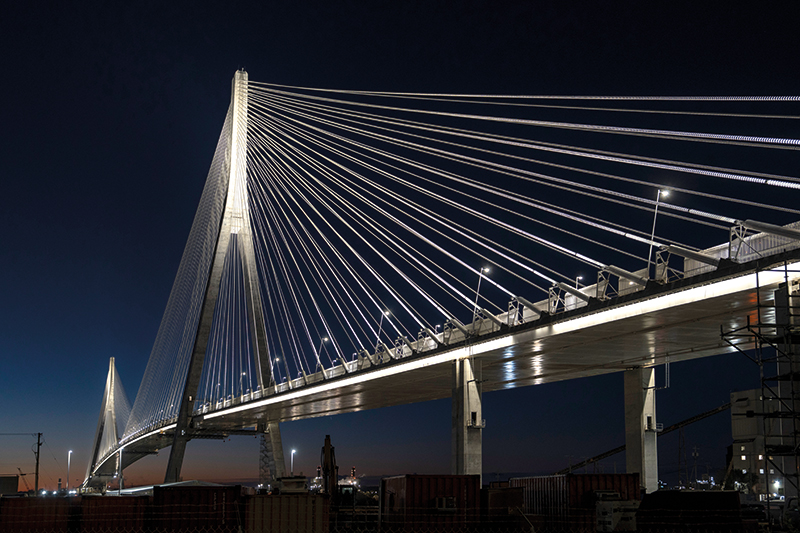
Twenty-five years in the making. Seven years of construction, and, at its peak, 2,500 workers on-site. Costing $6.4 billion and stretching 2.5 kilometres—the longest cable-stayed bridge in North America, rising 46 metres above the Detroit River—the Gordie Howe International Bridge is much more than these impressive numbers.
“The Gordie Howe International Bridge is a symbol of the friendship between Michigan and Canada and a testament to what’s possible when we work together,” said Michigan Governor Gretchen Whitmer when the bridge deck was completed last July.
2024 marked the first full year of normal international bridge operations across Ontario following the COVID-19 pandemic, due to varying degrees of border restrictions for safety reasons from March 2020 to May 2023. According to the Bridge and Tunnel Operators Association, traffic at all border crossings in the province is down since the start of the pandemic, but the association also revealed that the slow decline began in 2000, long before COVID-19 entered the lexicon. From 2023 to 2024, truck crossings decreased slightly, by 0.95 per cent. Despite these declines and the current Canada-U.S. Trade War, this bridge is a harbinger of repairing these recent political tensions. The Gordie Howe International Bridge is a long-term solution to ease capacity at North America’s busiest border crossing. It also represents a significant economic, social and environmental investment in the region.
“This is a 125-year design bridge,” says Charl van Niekerk, chief executive officer of the Windsor-Detroit Bridge Authority (WDBA). “It’s going to be around long after we’re all gone and long after we’ve forgotten about the current cross-border trade issues.”
Get van Niekerk talking about the Gordie Howe International Bridge, expected to open to traffic in early 2026, and it’s hard to stop him. The executive’s passion for this project is palpable; he is not the only one excited about the opening of this once-in-a-generation infrastructure megaproject. Members of the Canadian Building Trades Union (CBTU) were integral to building this remarkable engineering feat, and they proudly proclaim on their website that, “The Gordie Howe bridge will save truck drivers nearly 850,000 hours per year in wait times, versus waiting at the Ambassador Bridge.”
Construction started on October 18, 2018, and after more than 19 million work hours, the structure is complete. What remains before the first vehicle crosses the bridge is testing, re-testing and training.
“We are currently focused on testing to identify as many potential issues as possible and resolve them before the bridge opens,” said van Niekerk in an interview with ReNew Canada. “We are also providing all border agencies and our operating teams sufficient time to be ready to operate this new, modern land border crossing.”
In anticipation of its opening, the Canada Border Services Agency has added 250 officers to its staff and allocated new officer trainees to this project.
The Need
The Ambassador Bridge and the Detroit-Windsor Tunnel are both nearly a century old. Aging infrastructure is one reason for this new bridge. And, despite declines in border crossings in both directions in the last five years, the Ambassador Bridge faces capacity issues. In 2024, 6,155,794 total vehicles crossed this land border, 2,280,569 of which were trucks.
“The Ambassador Bridge is nearly 100 years old, and in private hands, so our focus is on three things,” van Niekerk says. “First, is the capacity needed for future growth. The crossings are at capacity, causing massive delays, especially for truckers. This new bridge solves that issue.”
The two additional key focus areas the Gordie Howe International Bridge addresses are efficiency and redundancy. Efficiency is achieved through the numerous new facilities and surrounding infrastructure on both sides of the border, including on-site truck inspection warehouses. Redundancy means that instead of competing directly with the Ambassador Bridge, this new structure offers travellers an alternative and becomes part of the Windsor-Detroit border-crossing network.
“This bridge is going to be such an amazing catalyst to economic growth,” says van Niekerk. “We are already seeing this growth in the region with companies making investments because they know the bridge is coming.”
This additional crossing is not only expected to improve travel and wait times but also to strengthen supply chains through the creation of brand-new ancillary buildings and infrastructure on both sides of the Gordie Howe International Bridge.
Much more than a “pretty bridge”
“Everybody focuses on the bridge,” van Niekerk says. “That’s obvious, because it’s a pretty thing to look at—and this bridge is phenomenal—but our two ports of entry are where the magic happens. These are the largest ports of entry on the Canadian-U.S. border and are built for future growth.”
Other significant pieces of this project, beyond the bridge, include upgrading the local roads: the Ojibway Parkway in Windsor, Ont. and the interchange onto I-75 on the Detroit side. “Once these are complete, it will create a seamless connection between these highways and you no longer will have to stop at a traffic light, which is one of the issues of the current infrastructure,” says van Niekerk.
Other parts of the Gordie Howe International Bridge project include pedestrian bridges and ramps that connect I-75 in Detroit to the U.S. port of entry, creating, for the first time, a direct highway-to-highway link to Highway 401 in Windsor. Additional buildings and infrastructure constructed on both sides of the border include cold storage, animal pens (for drug-detection dogs), inspection warehouses, truck parking, trailer bays and advanced large-scale imaging.
“We’ve got a massive control room,” says van Niekerk. “If you are a Star Trek fan, like me, it feels like you’re sitting in the bridge of the Enterprise!”
Bolstering communities
The new bridge not only connects Canada and the U.S., but it also bridges the gap between communities, providing residents on both sides of the border with new amenities.
“Connectivity is a big part of this massive infrastructure project,” says van Niekerk. “The bridge is not just connecting the two countries with an additional border crossing, but it’s connecting the diverse communities on both sides of the border, along with the surrounding areas and supporting infrastructure.”
Engaging these border communities and advancing economic, social and environmental conditions for residents in the environs of this new bridge was a crucial part of this project. The Community Benefit Plan, developed in collaboration—and through ongoing engagement and consultation—with the Windsor and Detroit communities, outlines the size and scope of these investments. The plan features two specific components: the Workforce Development and Participation Strategy and the Neighbourhood Infrastructure Strategy.
The Workforce Development and Participation Strategy established key metrics that the project team met, like 41 per cent of the labourers hired being local. “We’ve also had about 250 local businesses contribute goods and/or services thanks to pre-identifying, as part of this strategy, some low-dollar value contracts that fit well into the local environment,” says Heather Grondin, chief relations officer, Windsor-Detroit Bridge Authority.
The second part of the Community Benefits Plan, the Neighbourhood Infrastructure Strategy, which totalled $23 million, divided equally between the adjacent Windsor and Detroit communities. “With that money, we’ve invested in specific priority areas identified through community consultation,” Grondin explains. “Investments include arts programs, extension of trail networks, programming targeting youth and seniors and food security programs on both sides of the border.”
This strategy also provided additional benefits to local communities that included planting and distributing more than 1,200 trees to locals and a significant investment in enhancing the park systems, with building everything from a gazebo and additional seating areas to brand-new fitness equipment. “All of these investments reflect what each community wanted,” Grondin adds.
Caring for the environment
The Gordie Howe International Bridge was designed and constructed with sustainability—and a care for the environment—driving many of the business and engineering decisions. The project team are proud that the new bridge achieved ISO 1400135 certification and that all ancillary buildings supporting the new border crossing are LEED Silver certified.
“Sure, the bridge is beautiful, but the reason we have the longest span of any cable-stayed bridge in North America is because, early on, we decided that we did not want to touch the water, so that’s one reason why there are no piers in the Detroit River,” says van Niekerk. “Also, since there is heavy trade travelling on this river, we did not want to get into a situation where there is a conflict between our infrastructure and ships.”
The project team also did not want any potential spills on the bridge to impact the water system, so to mitigate this, they’ve built a fully self-contained water management and processing plant on site. “All the water on the bridge is captured, so any spills are redirected,” van Niekerk says. “We can then treat them before they’re released into the river.”
Future forward
The Gordie Howe International Bridge is a forward-thinking design that adapts in real time to traffic volume. “We’ve got six lanes, three in each direction, with the ability to change the direction of these lanes to facilitate growth,” says David Henderson, CEO, Bridging North America, the consortium created to design, build, finance, operate and maintain the Gordie Howe International Bridge through a P3 model. The consortium includes Aecon, ACS Infrastructure Canada and Fluor Canada. “Without making any structural changes to the existing bridge, we can also go up to eight lanes—four in each direction.”
The bridge was designed to incorporate new technologies as new efficiencies and discoveries are made, seamlessly adding to the existing infrastructure. “The sheer scale of this project and its importance to the local communities is phenomenal,” Henderson concludes. “We can see the light at the end of the tunnel, and everyone is excited. We are looking forward to opening the bridge as quickly as we can, but we want to make sure that we do it right.”
By the Numbers
6 lanes Three Canadian-bound, three U.S.-bound
2.5 kms Total length
853 metres Clear span
16 toll lanes
24 primary inspection lanes on Canadian side
36 primary inspection lanes on U.S. side
167 acres Total area of U.S. Port of Entry
130 acres Total area of Canadian Port of Entry
125 years Lifespan of bridge
2,500 jobs created
216 stay cables
Each stay cable has between 38 and 122 rope-like metal strands. Laid end-to-end, the strands would stretch from Windsor to Alaska.
David McPherson, based in Waterloo, Ont. is the author of The Legendary Horseshoe Tavern, Massey Hall and 101 Fascinating Canadian Music Facts.
[This article appeared in the January/February 2026 issue of ReNew Canada.]
Featured image: The Gordie Howe International Bridge will save truckers nearly 850,000 hours per year in wait times, versus waiting at the Ambassador Bridge. (WDBA)