
National defence infrastructure is the invisible backbone of a secure society, but the challenges of modernizing and expanding these systems across a vast, geographically diverse nation have never been more complex. As Canada moves toward the two per cent NATO spending benchmark, a projected $290 billion in capital investment is poised to transform the national defence landscape. This massive surge marks a pivotal moment for the infrastructure sector and construction industry.
Navigating this generational shift requires a complete rethinking of traditional execution models. From managing the stark environmental realities of the Far North to addressing nationwide skilled labor shortages and rigid security clearance frameworks, the defence sector is moving toward a highly integrated, deeply collaborative approach.
The critical strategies required to navigate this landscape were the central focus of a recent webinar hosted by ReNew Canada, and sponsored by PCL Construction. A panel of experts explored how early contractor alignment, planning redundancy, and procurement innovation are rewriting the blueprint for building the critical infrastructure that safeguards the nation.

The power of early contractor involvement
The traditional “design-bid-build” procurement model is increasingly viewed as a barrier to delivery efficiency, especially when dealing with highly specialized military installations. David Hudock, National Director of Defense and Federal Government Relations with PCL Construction, emphasized that bringing constructors, designers, and public owners together before a design is locked in is no longer a luxury—it is an absolute necessity for cost and schedule risk mitigation.
The federal government, primarily through Defence Construction Canada (DCC) and the Department of National Defence (DND), has made considerable strides by utilizing progressive delivery mechanisms like modified design-build and Integrated Project Delivery (IPD). These frameworks are specifically designed to execute front-end planning that de-risks the eventual construction phase, stabilizes pricing, and prevents the schedule slippage that frequently plagues public megaprojects.
“Collaboration is key and fundamental to the success of these projects,” Hudock explained. “The best, most effective projects are when as many or all of the parts and the stakeholders in a project right from the beginning, right to the end collaborate and work towards making sure we get the best output.”
In an inflationary climate where metal fabrication, structural steel, and specialized plumbing costs continue to escalate, waiting even a few years to advance a project exponentially increases the burden on taxpayers.
“Every year you wait, that the project that you want to have built is going to cost more,” Hudock warned. Early contractor involvement directly mitigates these inflationary shocks by enabling long-lead procurement. “If we can get a design in and know what our structural steel needs to be and order that structural steel even a few years ahead of time, that will save projects big money.”
Volume and complexity in the high Arctic
Nowhere is the necessity for rigorous planning and early collaboration more acute than in Canada’s Far North. Peter Crain, Principal with Colliers Project Leaders, summarized the Arctic challenge in two words: volume and complexity.
“DND has been planning, has had plans to expand its footprint in the North for a lot of years… And now the rubbers really hit the road,” said Crain. “So, the opportunity is here and it’s huge. It’s huge for Canada, it’s huge for Northern communities, and it’s huge for our Arctic partners as well.”
For over a decade, national defence planners have mapped out strategies to expand Canada’s northern footprint, but the geopolitical urgency of the present moment has accelerated those plans. The sheer volume of incoming work is unprecedented. DND is advancing forward operating bases, establishing “hubs and spokes” operational support concepts, implementing NORAD modernization, updating sensor defense networks, and building out Defence of Canada fighter infrastructure.
Crucially, this military build-up is occurring in tandem with major “nation-building” and economic development initiatives managed by the Major Projects Office (MPO), including the Mackenzie Valley Highway and the Gray’s Bay Arctic Security Corridor. This dual expansion will inevitably spark significant territorial and municipal development.
“We’re going to see probably population growth up there,” Crain explained. “With population growth, means municipalities need to expand their facilities. There needs to be housing. There’s a lot of infrastructure that’s going to go in to support the people that are supporting these new military installations up there.”
This immense volume collides directly with the absolute complexity of building above the treeline. Hudock noted that construction veterans who have spent decades working in Canada’s remote Arctic share a unanimous warning: everything standard about southern construction must be unlearned when moving north.
“Mother Nature will sometimes literally shut you down from being able to build for an entire season,” Hudock cautioned. Logistics in the Far North are entirely dictated by tightly constrained environmental windows. The vast majority of heavy building materials must be meticulously cataloged, packed, and shipped via sealift from regions like Quebec. These vessels have a restrictive three-to-four-month summer window to navigate ice-choked waters and complete their deliveries, according to Hudock. If a severe Arctic storm or unseasonal ice pack prevents a ship from reaching its destination, an entire year of construction can be lost instantly. While air transport via northern aviation hubs like Yellowknife or Inuvik remains an option for smaller components, flying in heavy structural materials is economically prohibitive and fundamentally alters the cost dynamic of a project.
To overcome these barriers, northern infrastructure must be approached with an unparalleled degree of planning redundancy. “Plan your construction project, plan your build, then plan it again, then start all over and plan it yet again,” said Hudock. “Everything has to be planned to the nth degree.”
Program synchronization
To prevent these massive capital investments from cannibalizing one another, Canada must move away from a siloed project mentality. Jeff Hamilton, Director and Senior Advisor for Defense and Security with EY, argued that the $290-billion portfolio must be managed through a comprehensive, “system of systems” view.
“The government’s going to need to treat this as one integrated Northern program that’s informed and synchronized with the relevant nation building projects managed by the MPO as well,” said Hamilton. This integrated perspective is essential because military infrastructure cannot exist in a vacuum; it remains heavily dependent on the baseline energy, transport, and logistics capacities of the local communities that host them.
A critical component of this systematic approach is program synchronization—understanding precisely which strategic pieces must be built first to enable subsequent phases of construction. Between 2027 and 2032, Canada will experience a massive concentration of defence infrastructure labor across its northern footprint.
“It’s hard to imagine how you’re going build top secret level facilities and support a fighter infrastructure when you haven’t got the operational support hub in place to do the receipt and dispatch of material, equipment, consumables, and even the human resources that need to flow up into the north and flow back for that matter,” Hamilton noted.
Furthermore, this synchronization must extend directly to northern energy infrastructure. Many remote northern communities remain almost exclusively reliant on finite quantities of fossil fuels transported up during brief seasonal windows—supplies that are strictly budgeted for local community consumption. Introducing massive military construction projects without concurrently upgrading regional energy generation would severely strain local grids and jeopardize community relations.
To maximize the socioeconomic return on these investments, DND is increasingly focusing on “dual use” infrastructure. Wherever operationally feasible, new defense facilities, airfields, transport corridors, and green energy installations should be structured to serve a dual purpose, said Hudock.
“There’s a military requirement for facilities, but those facilities could, should or potentially can be used by the local communities to assist everything that they’re doing.”
Procurement Innovation and Indigenous Capacity
For a $290-billion capital program to successfully fortify the nation, procurement must become substantially more agile, transparent, and socially accountable. Historically, public procurement has been viewed as a bureaucratic and burdensome exercise. However, recent initiatives indicate a positive shift toward transparency. DND and DCC have drawn praise from across the sector for launching comprehensive industry outlook days and standing up centralized, accessible web portals that detail upcoming capital infrastructure pipelines.
To further optimize these tools, Hamilton suggested adding deeper layers of programmatic data to public pipelines. He said clearly designating whether an upcoming tender involves standard civil security or high-level physical security allows contractors to pre-screen their supply chains and align cleared workforces well in advance.
The most profound opportunity for procurement innovation lies in rewriting how the federal government fosters Indigenous participation and capacity building. Historically, federal departments have approached Indigenous procurement through distinct strategies. According to Crain, Public Services and Procurement Canada (PSPC) has traditionally relied on a “set-aside” model to direct contracts to registered Indigenous businesses, while DCC has increasingly favored a mandatory, merit-based requirements approach within its Request for Proposals (RFPs). In recent northern defense tenders, up to one-third of an RFP’s evaluation score has been explicitly tied to defined Inuit benefits, assessing what concrete partnerships, employment opportunities, and long-term economic legacies a proponent will bring to local communities.
Crain noted that while both models have driven progress toward federal procurement targets, the unique demographic reality of the Far North requires industry to move beyond purely opportunity-based procurement. In isolated northern communities with small baseline populations, simply providing a contract opportunity is ineffective if the community lacks the immediate corporate infrastructure or specialized trade volume to execute it.
“We need to figure how we use the procurement tools to develop those capabilities to build capacity in these smaller markets using local folks and using Canadians,” Crain argued. True procurement innovation means leveraging federal defense spending as a foundational economic engine. By embedding long-term training, mandatory apprenticeships, and capital investment inside local corporate joints ventures, major defense builds can leave behind a permanent, highly skilled, and self-sustaining regional workforce.
Building lasting foundations
The defense of Canada is ultimately a generational responsibility. The choices made by infrastructure leaders, military planners, and government agencies today will irrevocably dictate the nation’s strategic and economic security through the middle of the century.
While advanced digital modeling, progressive contract delivery models, and structural engineering innovations are indispensable tools, the true foundation of a successful $290-billion defense build rests entirely on the strength of human relationships. Building highly secure, logistically complex facilities in punishing environments requires a level of institutional trust that cannot be manufactured overnight.
“Shareholders are all of Canada, all Canadians on this one, and we’ve got to get it right,” Crain concluded. “And it’s going to take all of us working together to do it.”
John Tenpenny is the Editor of ReNew Canada.
[This article appeared in the July/August 2026 issue of ReNew Canada.]
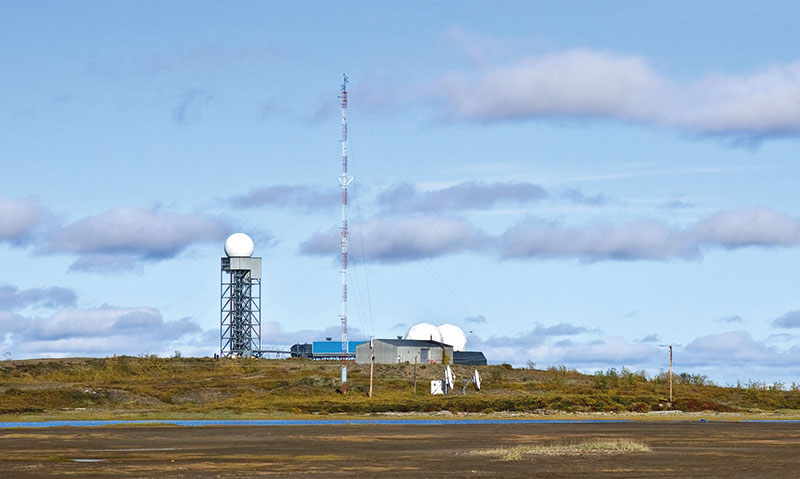
Featured image: Recently, Canada’s Department of National Defence, awarded a contract for Stage 1 of its the Arctic Over-the-Horizon Radar Program, a key NORAD modernization initiative that will advance the renewal of Canada’s North Warning System. (Getty Images)