
As one of Canada’s fastest growing and most diverse communities, the city of Mississauga faces an increasingly urgent demand for expanded healthcare infrastructure. To meet this challenge, Trillium Health Partners (THP), alongside Infrastructure Ontario and the Ministry of Health, has embarked on a landmark expansion: the construction of the Peter Gilgan Mississauga Hospital and Shaw Family Hospital for Women and Children.
A recent panel discussion at the Canadian Construction Association’s Best Practices in Construction Symposium in Toronto featuring key project leaders shed light on the scale, innovative procurement model, and complex operational dynamics required to build what will become one of the country’s most advanced healthcare campuses.
The Peter Gilgan Mississauga Hospital is No. 4 on ReNew Canada’s 2026 Top100 Projects report.

The sheer specifications of the new Peter Gilgan Mississauga Hospital place it among the largest health-infrastructure projects in Canadian history. Designed to replace an aging facility, the new hospital will span 2.8 million square feet across a 22-acre site located at the dense urban intersection of Hurontario Street and The Queensway.
Rising 22 stories, the state-of-the-art structure will feature:
- 950 Beds: All housed in private rooms to enhance infection control and patient dignity.
- Massive Emergency Capacity: Hosting one of Canada’s largest emergency departments.
- Expanded Surgical Capabilities: Doubling the hospital’s existing surgical capacity.
- The Shaw Family Hospital for Women and Children: Ontario’s first dedicated, purpose-built hospital space designed specifically for specialized pediatric and maternal care.
Before main construction could even begin, significant enabling works had to be completed on the constrained site, including the installation of a 1,500-spot parking structure and the relocation of existing long-term care facilities.
To deliver a project of this magnitude, the team bypassed traditional fixed-price P3 delivery models in favor of a Progressive Design Build approach, being carried out by ED+PCL Healthcare Partners joint venture made up of EllisDon and PCL Construction. As Scott Hunter, VP, Operations with EllisDon explained, the traditional procurement models often restrict direct client feedback through rigid fairness monitoring.
In contrast, the progressive model brought the owner (THP), the Ministry of Health, Infrastructure Ontario, and the construction team directly to the same table. This allowed for a two-year collaborative design development period prior to commercial close.
“(The model) gives both sides, client and general contractor more certainty on what the design is ultimately going to end up as, it allows for appropriate risk redistribution which isn’t really possible under commercial tension in the typical model,” said Hunter.
This extended runway enabled intensive user-group sessions with clinical staff, allowing for real-time value engineering and customizable designs. The result is a model that provides greater design certainty, ensures funds are directed where they matter most for patient care, and rebalances risk fairly among all partners.
While forming a joint venture between traditional competitors can introduce organizational anxiety, project leaders had to admit “our own weaknesses and exploit the other’s strengths, and vice vers,” said Hunter.
“What we did was in the best interest of what was required by the project, so we combined the best of EllisDon and PCL into aa machine and a culture that was bespoke for the Trillium Project, and there is really no distinction between EllisDon and PCL people on site.”
According to Matthew Kenney, THP’s associate VP, this union created a deep bench of specialized talent. The setup fosters a culture of friendly competitive tension that drives accountability, ensures mistakes are corrected swiftly, and presents a single, seamless team on-site.
Perhaps the most daunting task facing the team is executing heavy civil construction directly adjacent to an existing, fully operational hospital running 24/7/365.
Because delicate surgeries, intensive care, and sensitive MRI scans are taking place just meters away, environmental controls are non-negotiable. The team actively manages dust, noise, vibration, and scents to prevent any impact on patient safety. High-risk operational handovers—such as transitioning the hospital’s primary medical gas storage facility to a new supply network without disrupting ICU or surgical suites—require months of rigorous, advanced simulation and coordination with hospital leadership.
“With the progressive design goal in the in the development phase we had the benefit of sitting around a table and going through the design of this hospital, and with that came the construction phase and logistics plan around how we’re going to bring it into the hospital in a way that allows the existing hospital to continue to operate,” said Kenney.
Compounding these clinical sensitivities is a tight urban footprint. The 22-acre site is effectively “locked in” by a busy four-lane roadway, the active existing hospital campus, and adjacent construction for the new Hazel McCallion Light Rail Transit (LRT) line.
As the project advances, logistical pressures will only intensify. Workforce management is slated to become increasingly complex as on-site activity peaks over the next two years, bringing an estimated 2,500 to 3,000 workers to the property simultaneously.
The central question now facing project leaders is how the team will maintain daily construction productivity while orchestrating the movement of thousands of tradespeople, heavy machinery, and material deliveries within such a tightly constrained “sardine can” footprint—all while safeguarding the vital healthcare operations continuing right next door.
“Because you know, once when you’re delivering projects of this scale, the challenge isn’t just building the building, right? It’s integrating the people into the process,” said Marco Dipelino, general superintendent, operations with PCL Construction.
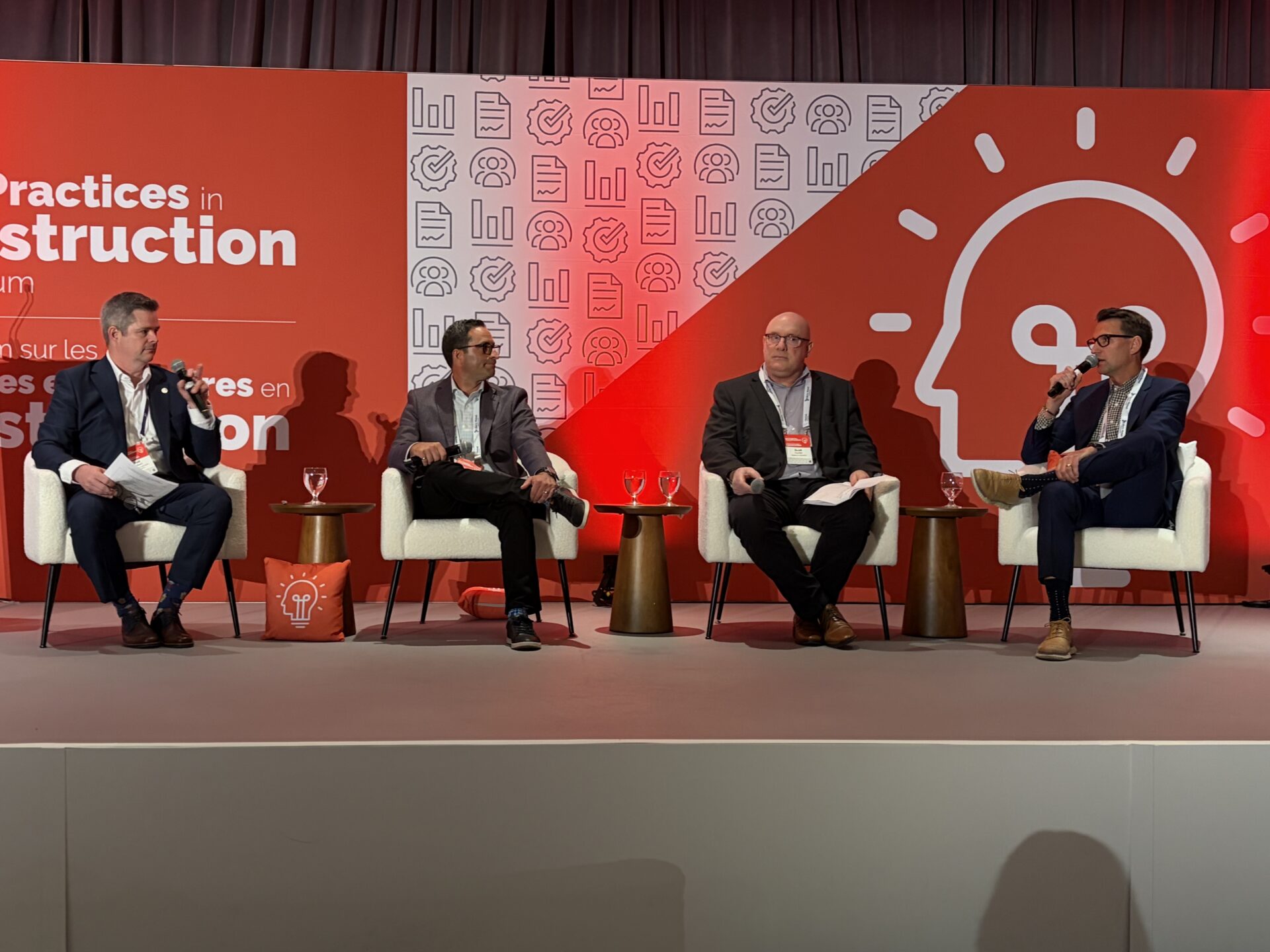
Featured image: (L to R) Rod Gilbert, President, CCA; Marco Dipelino, PCL Construction; Scott Hunter, EllisDon; and Mathhew Kenney, Trillium Health Partners. (ReNew Canada)