
The Government of Ontario announced it is investing $2,804,955 through the Northern Ontario Heritage Fund Corporation (NOHFC) in strategic infrastructure upgrades at the Port of Thunder Bay and the Peninsula Harbour Port Authority in Marathon.
“By expanding the Port of Thunder Bay and creating a new marine terminal in Marathon, we’re helping Northern Ontario ports increase cargo volumes to ship everything from grain and potash to components for pipelines and critical minerals from the Ring of Fire,” said Premier Doug Ford.
The Thunder Bay Port Authority (TBPA) is receiving $804,955 in NOHFC funding to expand its staging and storage area at Keefer Terminal by 10 acres, increasing its capacity for goods such as wind turbine parts, steel and oversized cargo. The expansion will allow the TBPA to increase cargo volumes and retain existing business, while reinforcing Thunder Bay’s role as a resilient and competitive gateway for interprovincial and international trade.
“The Port of Thunder Bay is grateful for the province of Ontario’s support through the Northern Ontario Heritage Fund Corporation, which supports expansion and efficiency improvements at Keefer Terminal. Strategically located as the furthest inland port in Canada, this premier intermodal facility is a vital supply chain link serving western Canada and Northern Ontario. Expanding laydown capacity will enhance our ability to handle increased and more diversified cargo, supporting inbound opportunities and improving vessel availability for bulk exports,” said Chris Heikkinen, CEO, Port of Thunder Bay.
With over 10.7 million metric tonnes of cargo, including grain, potash and natural resources, moving through its facilities in 2025, and the vast majority shipping domestically or to international markets other than the U.S., the Port of Thunder Bay is one of Canada’s critical inland ports and a gateway to western Canada and Europe. Strategically located at the western end of the Great Lakes St. Lawrence Seaway System and connected to marine, rail and road networks, it is a key part of the region’s industrial supply chain serving key sectors such as mining, manufacturing and forestry.
In addition, the Peninsula Harbour Port Authority (PHPA) is receiving $2 million in NOHFC funding to repurpose unused commercial docks in Marathon at the site of the former Marathon Pulp mill to create a marine terminal for shipping regional materials such as critical minerals, forest products, road salts and components for pipelines and wind turbines, to southern Ontario and customers across the globe. The PHPA was incorporated in November 2020 through an equal partnership between the Town of Marathon and Biigtigong Nishnaabeg First Nation and is expected to be operational by late 2027, supporting local business growth and good-paying jobs.
“Our government is supporting access to cost-efficient marine transportation for resource and industrial operations located in northwestern Ontario,” said George Pirie, Minister of Northern Economic Development and Growth. “We are helping these ports be better positioned to attract new cargo and expand existing business, reinforcing northwestern Ontario’s role as a competitive gateway for provincial, interprovincial and international trade.”
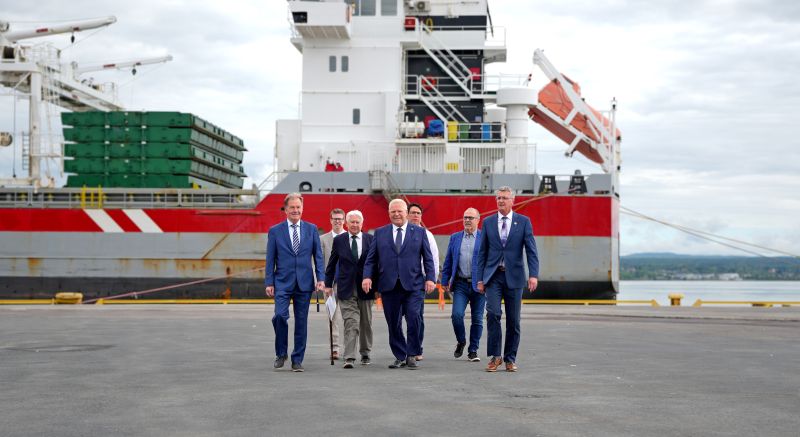
Featured image: (Government of Ontario)