By Jamie Andersen, Reena Sahney, Ashley Lawson, and Katie Kapscos
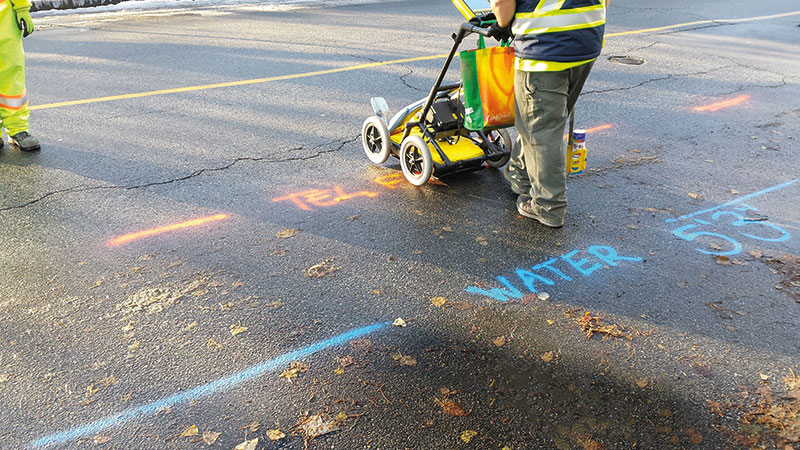
Modern infrastructure depends on what we cannot see. Beneath roads, rights of way, industrial sites, and urban corridors lie an increasingly dense network of energy, water, telecommunications, and municipal services that enable daily life and economic activity. In Canada, the collective length of oil and gas pipelines alone (about 760,000 kilometres) could circle the globe almost 19 times. Identifying and marking these underground facilities is the role of locators, an essential but often underappreciated function. Locators are among many practitioners that help to preserve existing underground infrastructure while other infrastructure projects move through early design through construction, operations, and long-term maintenance.
Despite its critical role, underground facility locating as part of the “click before you dig” process is frequently treated as a compliance task, triggered late in the project lifecycle and framed primarily as a regulatory checkbox rather than a foundational risk control. At the same time, the locating sector is facing mounting workforce pressures driven by retirements, limited career visibility, and challenges in skills development and transfer. These pressures are no longer an abstract industry concern; they are translating into tangible project risks that affect safety, cost certainty, schedule reliability, and asset integrity across energy and municipal infrastructure systems.

Reframing how the industry understands and invests in locating, and the workforce that delivers it, is becoming essential to resilient infrastructure delivery.
Locating as a system function, not a field service
At its core, underground facility locating is about managing uncertainty. Locators translate incomplete records into actionable information that allows engineers, constructors, and owners to make safe decisions about where and how to build. This function supports far more than excavation safety alone.
During early project planning, reliable subsurface information informs design choices, constructability reviews, and cost estimates. During construction, accurate and timely locates help prevent utility strikes and support efficient sequencing and execution of project work. Over the life of an asset, well-documented subsurface knowledge improves maintenance planning and emergency response.
When locating capacity or quality erodes, uncertainty expands. That uncertainty shows up as inflated contingency allowances, schedule buffers, or worse, unanticipated failures in the field. In this sense, locating is not a discrete service but an important risk management tool.
Workforce pressures beneath the surface
The locating workforce is under strain. Across North America, a significant portion of experienced locators are approaching retirement, taking with them decades of tacit knowledge about local infrastructure, utility behavior, and site-specific anomalies. Replacing this expertise is not straightforward.
Further, locating has historically been a “hidden” career, as it has lacked visibility as a potential career path. It is rarely discussed in high schools, engineering curricula, construction management programs, or workforce development strategies, despite its technical complexity and safety critical nature. Entry into the profession often occurs by chance rather than design, and progression pathways can be unclear. As a result, recruitment struggles to keep pace with demand, particularly as infrastructure investment accelerates and locate request volumes increase.
Training presents additional challenges. While technology has advanced (for example, introducing digital ticketing systems, improved detection equipment, and data management tools), the fundamental work of interpreting signals, resolving conflicts, and exercising judgment in complex environments remains deeply experiential. Transferring this judgment from senior locators to new entrants requires time, mentorship, and structured learning frameworks that are not consistently available across the industry. The result is a growing disparity between the demand for locating capacity and the workforce available to deliver.
When workforce gaps become project risks
The effects of workforce shortages and inconsistent skill levels do not remain confined to the locating sector; they propagate outward into project execution.
One of the most visible consequences is an increased risk of utility strikes. The interpretation of complex subsurface conditions requires an experienced practitioner, given adequate time, space, and support. Constraints to these resources, whether from workforce gaps or project pressures, increase the likelihood that facilities are missed, misidentified, and subsequently damaged. Utility strikes carry immediate safety hazards ranging from service disruptions to fires, explosions, or electrocution. However, their impacts can extend much further.
A single strike can halt construction for days or weeks, trigger regulatory investigations, and require costly emergency repairs. Downstream effects may include insurance claims, schedule delays, reputational damage, and strained relationships between owners, contractors, and utility operators. For linear infrastructure or dense urban projects, repeated minor strikes can cumulatively erode project viability.
Workforce constraints also affect schedule certainty. As locate request volumes increase and response times stretch, projects may face delays before ground disturbance can even begin. In fast-tracked or tightly sequenced projects, these delays can cascade, disrupting subcontractor mobilization, material deliveries, and other logistical plans.
From an asset perspective, poor subsurface knowledge can result in long-term operational vulnerabilities. Facilities that are inadvertently damaged, inadequately protected, or inaccurately documented during construction may perform poorly over time, increasing maintenance costs and failure risk. In this way, locating workforce readiness directly influences not only project delivery but also the lifecycle performance of infrastructure systems.
Industry-led efforts to strengthen the locating profession
In response to these challenges, industry-led initiatives are emerging to improve career awareness, role clarity, and competency within the locating sector.
The Canadian Association of Pipeline and Utility Locating Contractors (CAPULC) is one organization undertaking such innovative workforce development initiatives. CAPULC, in collaboration with Jiva Consulting, has led a multi-year initiative to meet the challenge of recruiting and preparing candidates for this often-overlooked career.
First, CAPULC began working to formalize the locating career, independently developing a series of competency requirements that specify the knowledge and skills required by locators to be effective within their roles. Later, CAPULC worked with Jiva Consulting to leverage these competency requirements and develop the Underground Facility Locating and Marking Standard. This foundational effort provided consensus-based technical and practical guidance to those in the locating field.
Next, CAPULC looked to take on the challenge of attracting a more sustainable supply of candidates to a vocation more commonly perceived as a transient field role. By leveraging career awareness initiatives, CAPULC aims to shift that perspective and reposition underground facility locating as a technical career path with progression opportunities, attracting candidates who value long-term skill development and responsibility. This shift is especially important for long-term workforce sustainability, as infrastructure owners and policymakers look to support decades of asset buildout in Canada.
With that, CAPULC and Jiva Consulting collaborated to launch a career awareness campaign aimed at both prospective employees and employers. Through the development of a position profile and career roadmap, CAPULC aims to formalize the entry paths and progression opportunities within the locating career. Offering these resources and promoting the position through a series of career awareness outreach sessions equips job seekers to make an informed decision in pursuing this career path.
The next step, targeting employers, is to build on this understanding and integrate competency-based assessment into the earliest stages of recruitment, even before hiring and training begin. Consequently, CAPULC and Jiva Consulting are developing a UFL Applicant Pre-Screening Tool, offering employers a consistent, competency-aligned way to assess prospective candidates’ problem-solving, judgment, ethics, and interpersonal capability. The tool is expected to launch in 2026, representing a major step toward a competent and effective locating workforce.
Implications for owners, engineers, and policymakers
For infrastructure owners, the message is clear: a competent, well-prepared locating workforce can minimize asset risk. Decisions about procurement models, project schedules, and data standards all influence the capacity and quality of locating services. Owners who engage locators early can therefore reduce downstream risk and improve lifecycle outcomes.
Engineers play a critical role in integrating subsurface considerations into design rather than deferring them to construction. Recognizing the limits of available data and collaborating with locating professionals during planning can surface constraints and opportunities that are invisible on paper. This can help optimize the project design and reduce project execution risk.
Policymakers and regulators also have a stake in supporting infrastructure resilience by supporting initiatives aimed at these skilled workforces. Regulator support of industry-led standards, training initiatives, and data quality improvements can deliver safety and economic benefits that far exceed their cost.
Repositioning locating as foundational infrastructure
Underground facility locating sits at the intersection of safety, cost control, and system resilience. The current workforce pressures facing the locating sector expose a deeper issue: a mismatch between the importance of the function and how it is valued, planned for, and resourced.
The integral yet often overlooked role of underground infrastructure in daily life parallels the role of the locator in modern infrastructure delivery. The locator’s work (like the water mains and the gas lines) is nearly invisible when it is done perfectly. But failures and their consequences reveal the true significance of their work.
Repositioning locating as a foundational component of modern infrastructure delivery requires a shift in mindset. It means moving upstream, investing in people as much as technology, and treating subsurface knowledge as strategic infrastructure in its own right. As energy and municipal systems grow more complex and interconnected, the ability to understand and protect what lies beneath our feet will only become more critical. Strengthening the locating workforce is not just about filling jobs, it is about safeguarding the reliability, safety, and longevity of the infrastructure systems that communities depend on.
Jamie Andersen is Co-Owner of First Alert Locating Ltd.
Reena Sahney, P.Eng., MSc, MBA, is the Founder and President of Jiva Consulting.
Ashley Lawson, P.Eng., is Project Manager with Jiva Consulting.
Katie Kapcsos is a research analyst, technical writer, and project manager with Jiva Consulting.
[This article appeared in the July/August 2026 issue of ReNew Canada.]
Featured image: Identifying and marking underground facilities is the role of locators, an essential but often underappreciated function. (Getty Images)