
By Douglas McNeill
Canada is investing at scale in new vessels for the Royal Canadian Navy, the Canadian Coast Guard, and the federal port system. As those fleets approach delivery, attention is increasingly turning to the shore infrastructure that will support them. In many cases, the cost planning frameworks used to estimate that infrastructure, were developed for land-based assets, not marine works—and the implications of that mismatch are now emerging across federal programs.
Generational fleet renewal is underway across Canada’s federal marine estate. Through the National Shipbuilding Strategy, new Arctic and Offshore Patrol Ships are already in service, with Joint Support Ships and Canadian Surface Combatants to follow. The Canadian Coast Guard is renewing its own fleet, while federal ports are being recapitalized on both coasts and in the Arctic. Each of these programs carries its own mandate, business case, Treasury Board submission, and political context.

What they share is a common dependency that receives far less attention. Every vessel must berth, service, and operate from shore infrastructure that is, in many cases, significantly older than the fleet it supports. Jetties, wharves, and marine terminals across the federal estate are themselves subject to major capital programs. The cost estimates underpinning those programs are developed using frameworks that were designed for a different class of infrastructure. The result is not an isolated delivery issue, but a recurring pattern of structural underestimation that is increasingly visible where federal program outcomes have reached the public record.
A federal jetty is not a building beside water
When a senior executive approves an early estimate for a conventional office building, the method behind that number is well established. Cost benchmarks are available; allowances and contingencies are broadly calibrated, and the range of likely outcomes is reasonably well understood. While uncertainty remains, its scale and drivers are familiar.
Federal marine projects operate under different conditions. Marine cost estimates are shaped by categories of work that have little direct equivalent in land‑based infrastructure: subsea rock drilling and blasting; dredging and disposal of seabed sediments, often contaminated and sometimes requiring long‑distance disposal routes; engineered residual‑risk capping; extensive turbidity and silt control; deep piling through variable seabed conditions; and specialist corrosion‑protection systems designed for decades of exposure. These sit alongside bespoke fendering and mooring systems, engineered for specific vessel classes and load cases, and delivered within tight seasonal and environmental windows by a limited pool of specialized contractors.
For experienced marine contractors, these conditions are well understood. For cost‑planning frameworks calibrated on vertical and horizontal construction, they often remain implicit. When such risks are absorbed into generic percentage allowances early in the project lifecycle, estimates tend to under‑reserve in systematic ways. In this context, a 15 per cent contingency on a $500 million marine program may appear prudent, but it is rarely sufficient.
The estimate reflects the requirement it serves
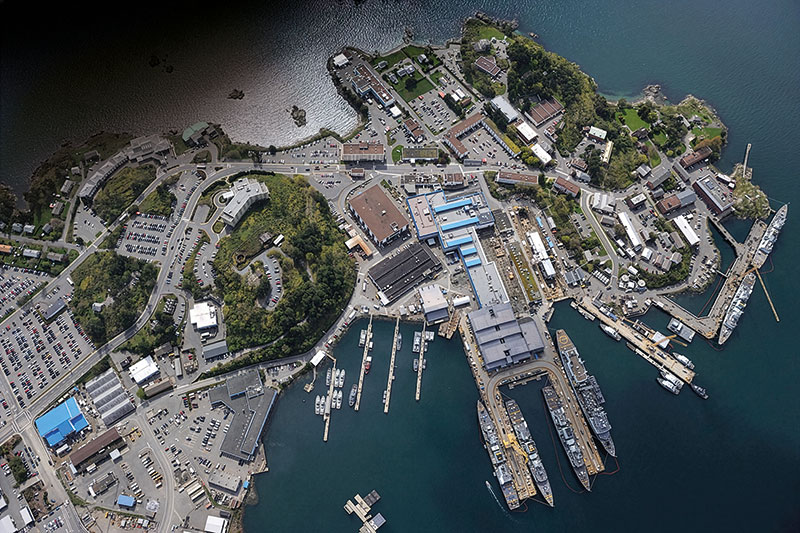
Federal marine projects also exhibit a second, less visible vulnerability. A jetty estimate is not simply an estimate of a structure; it is an estimate of infrastructure configured to support a defined set of vessels. Changes in vessel length, displacement, power demand, or mooring configuration translate directly into changes in jetty length, deck loading, fendering, utilities, and dredging scope—with material cost consequences.
This tight coupling between fleet specifications and shore infrastructure creates a recurring governance challenge: operational requirements are often still evolving when infrastructure cost estimates are locked. The 2014 audit of the A and B Jetty Recapitalization Project at CFB Esquimalt, published by the Assistant Deputy Minister (Review Services) and available on the public record, illustrates this dynamic. The audit found that the project’s Statement of Operational Requirements was internally inconsistent on whether the new jetties were required to accommodate future Canadian Surface Combatants or merely to take them into consideration—a distinction with significant downstream cost implications. It also noted inconsistency in departmental guidance on allowances and contingency, making divergent risk pricing outcomes possible across similar projects.
These findings are not a critique of teams delivering the work. They reflect the planning and governance context in which federal marine programs operate. The same conditions recur across multiple portfolios, particularly where ambitious operational requirements intersect with early-stage estimating frameworks not tailored to marine assets.
Where cost pressure typically emerges
Public-sector cost overruns are often attributed to construction-phase challenges: unforeseen ground conditions, adverse weather, or contractor performance. While these factors play a role, they rarely explain the full gap between early estimates and final outturns on federal marine projects. More often, that gap was established years earlier.
There are three recurring mechanisms, the first of which is the evolution of requirements. As fleet programs mature, vessel specifications change. Unless those changes are promptly reconciled with dependent infrastructure projects, estimates quickly fall out of alignment. By the time re-baselining occurs, the delta is often substantial, and the governance and reputational barriers to revisiting approvals are high.
The second mechanism is the treatment of marine‑specific risk. Below‑water geotechnical uncertainty, contaminated sediment volumes, environmental work‑window constraints, and specialist contractor availability all carry uncertainty profiles that are wider and more asymmetric than those typically encountered on land. When priced as generic contingencies rather than discrete, explicit risk categories, these drivers are routinely under‑represented—and their interactions can compound cost pressure rather than offset it.
The third mechanism is schedule, as Marine programs are particularly vulnerable to delay, and delay translates directly into cost escalation. Seasonal access constraints, permitting cycles, Indigenous consultation commitments, and limited specialist capacity make schedule recovery more difficult than on many land-based projects. Estimates built on schedules the project cannot realistically maintain tend to be corrected later, and at scale.
Four practical actions program leaders can take
The issue is not that federal marine programs are unmanageable, nor that cost growth is inevitable. It is that estimating practice needs to better reflect the asset class it is applied to. There are practical steps that can be taken within existing governance structures.
First, marine‑specific risks need to be priced explicitly and transparently, rather than absorbed into global allowances. Subsea conditions, contaminated materials, contractor availability, seasonal access, and vessel‑specification volatility should each be identified as distinct cost drivers, with defined ranges and assumptions.
Secondly, cost estimates should avoid being locked until operational requirements have been reconciled across all interdependent fleet and infrastructure programs. This may extend early planning stages, but it reduces the risk of committing to figures that were built on unresolved or contested assumptions.
Thirdly, marine benchmarking for large jetty and terminal projects should be commissioned independently, separate from the primary design team. Global comparators are often essential, given the limited size of the Canadian reference set and the consistency of early-stage underestimation across jurisdictions.
Lastly, the schedule should be treated as a primary cost driver. Scenario-based pricing across realistic delivery ranges, rather than a single most likely case, produces estimates with more meaningful uncertainty bounds and fewer downstream adjustments.
The conversation ahead
None of this detracts from the capability or commitment of those delivering Canada’s federal marine infrastructure. The observation is that the frameworks guiding early decision-making are largely developed for a different class of asset, and that this difference manifests in consistent, documented ways once programs mature.
The fleets are coming; vessels are being built and delivered on timelines that will not wait for shore infrastructure to catch up. The question for senior leaders is not whether every current estimate will prove accurate, as experience suggests many will not. The question is whether the estimating frameworks that produced them are sufficiently robust enough to support the next wave of marine investment—or whether familiar patterns are about to repeat at a larger scale. That is a more difficult conversation, but it is also the one worth having before the next set of submissions are made.
Douglas McNeill is a Director with Turner & Townsend.
[This article appeared in the July/August 2026 issue of ReNew Canada.]
Featured image: A jetty estimate (CFB Esquimalt pictured) is not simply an estimate of a structure; it is an estimate of infrastructure configured to support a defined set of vessels. (MCpl Chris Ward, Imaging Services, CFB Esquimalt (DND-MND Canada))