
By Jonathan Curley
Recreation infrastructure in remote northern regions demands a rare combination of resilience, practical innovation, and community determination. Across B.C., Alberta, Saskatchewan, Manitoba, and the territories, outdoor municipal pools, indoor aquatic centres, and arenas are central to health, safety, and quality of life. Yet the realities of building and operating these facilities in remote settings are far more complex than in southern or urban centres.
“Designing and constructing recreation facilities in remote locations experience, in equal measure, elevated importance and reduced risk tolerance. Remote communities have smaller populations that rely heavily on the few available recreational assets and reduced access to capital which cannot withstand projects that balloon costs,” explains Glen Stokes, Partner Architect, Carscadden Stokes McDonald Architects Inc.

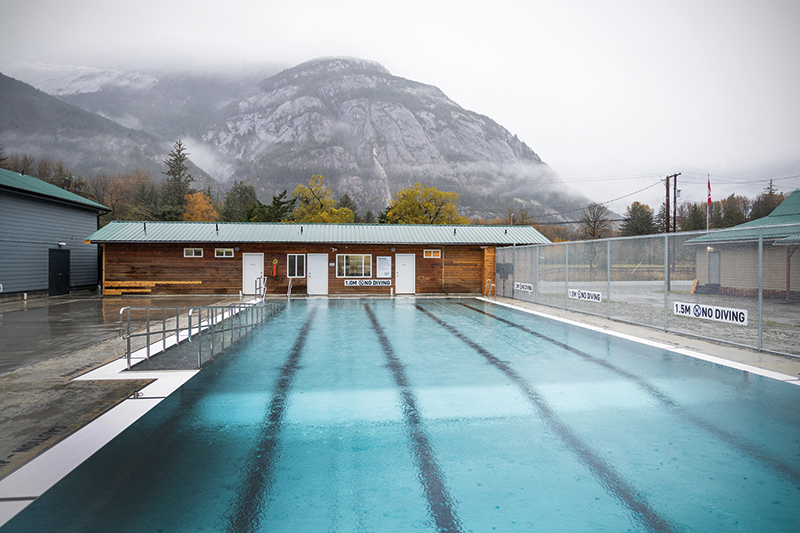
The recently completed Bella Coola (B.C.) Centennial Pool project, delivered by Chandos Construction with a multidisciplinary team of architects and engineers, offers a concrete example of what can work. More than a seasonal recreation facility, the Bella Coola pool shows how remote communities can replace aging infrastructure with amenities that are affordable to operate, built for local conditions, and deeply rooted in community life.
Northern reality
Recreation infrastructure in northern and remote communities must contend with distance, climate, aging facilities, and limited local capacity. These pressures increase cost and risk at every stage, so projects must prioritize durability, simplicity, and long-term value from the outset. The Bella Coola pool illustrates how design and delivery choices can turn those constraints into a manageable, long-lived asset.
Remote locations mean higher construction and operating costs. Materials often travel long distances by barge, winter road, or air, and specialized aquatic contractors are rarely local, so mobilization alone can absorb a major share of the budget. Short construction seasons further compress already tight schedules, while harsh weather demands robust filtration, durable finishes, and efficient heating that can handle extreme conditions and a brief operating window.
In Bella Coola’s coastal valley, Chandos Construction coordinated material deliveries and contractor travel around narrow seasonal and weather windows. A prefabricated stainless-steel basin helped streamline installation, reduce weather risk, and lower lifecycle costs. High-efficiency heating, optimized circulation, and intuitive mechanical systems designed by AME Group help cut energy use in a region where utilities are limited and power often relies on costly diesel or propane generation. Together, these choices keep day-to-day operations manageable for a small local team and help control long-term operating costs.
Replacing aging infrastructure
Many northern pools built in the 1960s to 1980s are past their lifespan, with structural issues, outdated systems, high energy use, and poor accessibility. Bella Coola faced this reality with its former outdoor pool, which had served generations but was no longer sustainable.
Working with Carscadden Stokes McDonald Architects, Chandos delivered a modern, efficient, and accessible replacement designed for long-term reliability. Durable, low-maintenance materials such as stainless steel, combined with energy-efficient systems, reduce both maintenance demands and reliance on specialized trades. For a remote community where every delivery, repair, and service call is costly, those reductions are critical to keeping the facility open and affordable.
To overcome the region’s limited supply chains and long transportation timelines, the team shifted from traditional cast-in-place concrete construction to a prefabricated stainless-steel pool system manufactured in Czechia. This approach allowed the basin to be fabricated overseas while site preparation was underway, significantly reducing schedule and logistical risks.
Beyond its logistical benefits, the stainless-steel system was selected for its performance in Bella Coola’s unique environmental conditions. Located within a 200-year floodplain, the region experiences periodic groundwater surges that create challenges for traditional concrete construction.
“Pools are designed to hold water, but here, we also had to manage water pushing in from the backside,” said Dominic Ries, Director of Technical Solutions, Pre-Construction at Chandos. “Stainless steel eliminated permeability concerns and offered far better long-term resilience against groundwater saturation and against traditional damp-proofing on concrete swimming pool tanks.”
Achieving this outcome required careful planning and risk management, says Stokes.
“The combination of the above factors in Bella Coola meant that the window for success was narrow and, at multiple points, the project appeared to be at jeopardy. Careful planning before construction, including onboarding Chandos as Construction Manager, allowed us to manifest success here.”
A collaborative team in action
The success of the Bella Coola Centennial Pool project—completed one month ahead of schedule—rested on a coordinated, multidisciplinary team.
Each partner brought technical expertise and a shared commitment to a facility that reflects the needs and identity of the Bella Coola Valley. Carscadden focused on community identity and accessibility. AME Group engineered pool and mechanical systems that balance performance with efficiency. RJC developed structural solutions suited to the region’s climate and seismic conditions, while O’M Engineering provided reliable, efficient electrical systems for remote operations.
Supported by Chandos’ collaborative construction model, the team aligned design, constructability, and long-term operations so the finished pool is both technically robust and practical for local staff to run.
Reflecting on the approach, Stokes adds, “For this project, the collaboration with the community, the Construction Manager and the consulting team resulted in a renovation that parsed the project to minimize risk. For example, the change rooms could be retained untouched, the new mechanical building could be replaced with local materials, and the stainless-steel pool and filtration systems were sourced elsewhere in a modular format for quality and cost certainty.”
Community impact and regional benefits
Recreation infrastructure like Bella Coola’s new outdoor pool strengthens northern communities by improving health, safety, social connection, and local economies. The pool offers a safe space for youth, families, and Elders to be active, learn water safety, and spend time together. In a region with few seasonal amenities, it has quickly become a summer hub for swimming lessons, family recreation, youth programs, and community events.
The project also generated local employment during construction and continues to support seasonal jobs in operations. Chandos prioritized local hiring wherever possible so more of the economic benefit remains in the valley. Because the facility uses efficient systems and a durable stainless-steel basin, operating and maintenance costs are easier to manage, which helps the community keep programs accessible.
Positioned as a regional asset, the pool serves neighbouring communities as well. Its design and programming support shared use, strengthening ties across the Bella Coola Valley and surrounding areas.
A blueprint for northern resilience
Bella Coola’s new outdoor pool is more than a local improvement. It offers a practical template for other remote communities that are deciding how to replace aging pools and arenas. By pairing durable materials with efficient systems, matching design to local capacity, and using a collaborative project model, the team created a facility that can stand up to northern conditions without overwhelming the community’s resources.
As northern communities across B.C. and the broader provinces confront similar pressures on aging recreation infrastructure, the Bella Coola project provides tested strategies rather than abstract ideals. It shows that with clear priorities, the right partners, and a focus on long-term value, remote regions can build and operate recreation facilities that support health, culture, and regional connection for decades to come:
Johnathan Curley is Technical Solutions Manager at Chandos Construction.
[This article appeared in the September/October 2026 issue of ReNew Canada.]
Featured image: Chandos Construction completed the new Bella Coola Centennial Pool, replacing an aging 1967-era facility with a modern and resilient recreation asset for one of the most remote communities on B.C.’s central coast. (Chandos Construction)