
By Rob Thornton
A proven energy technology is already at work in 200 Canadian communities. This June, the world comes to Ottawa to see what’s next.
This June, energy industry leaders will come to Canada to learn. Delegates from across 28 countries are expected to gather in Ottawa for IDEA2026, the 117th Annual Conference and Trade Show of the International District Energy Association (IDEA).

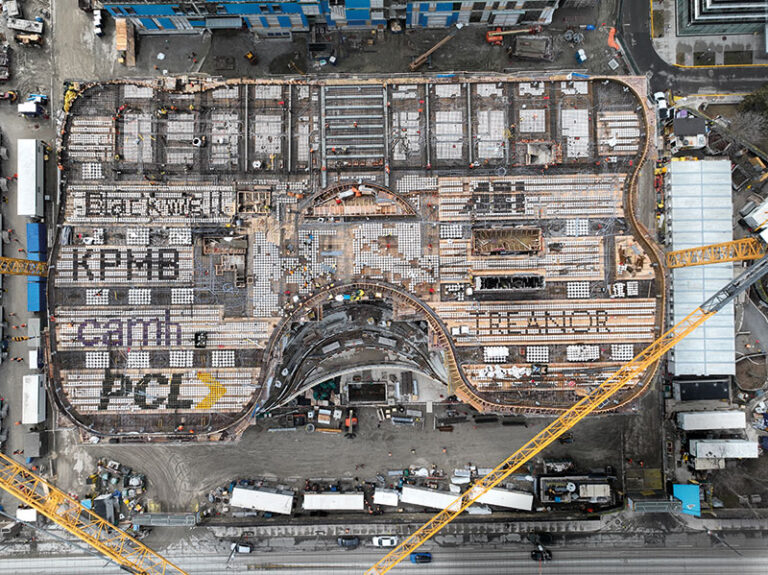
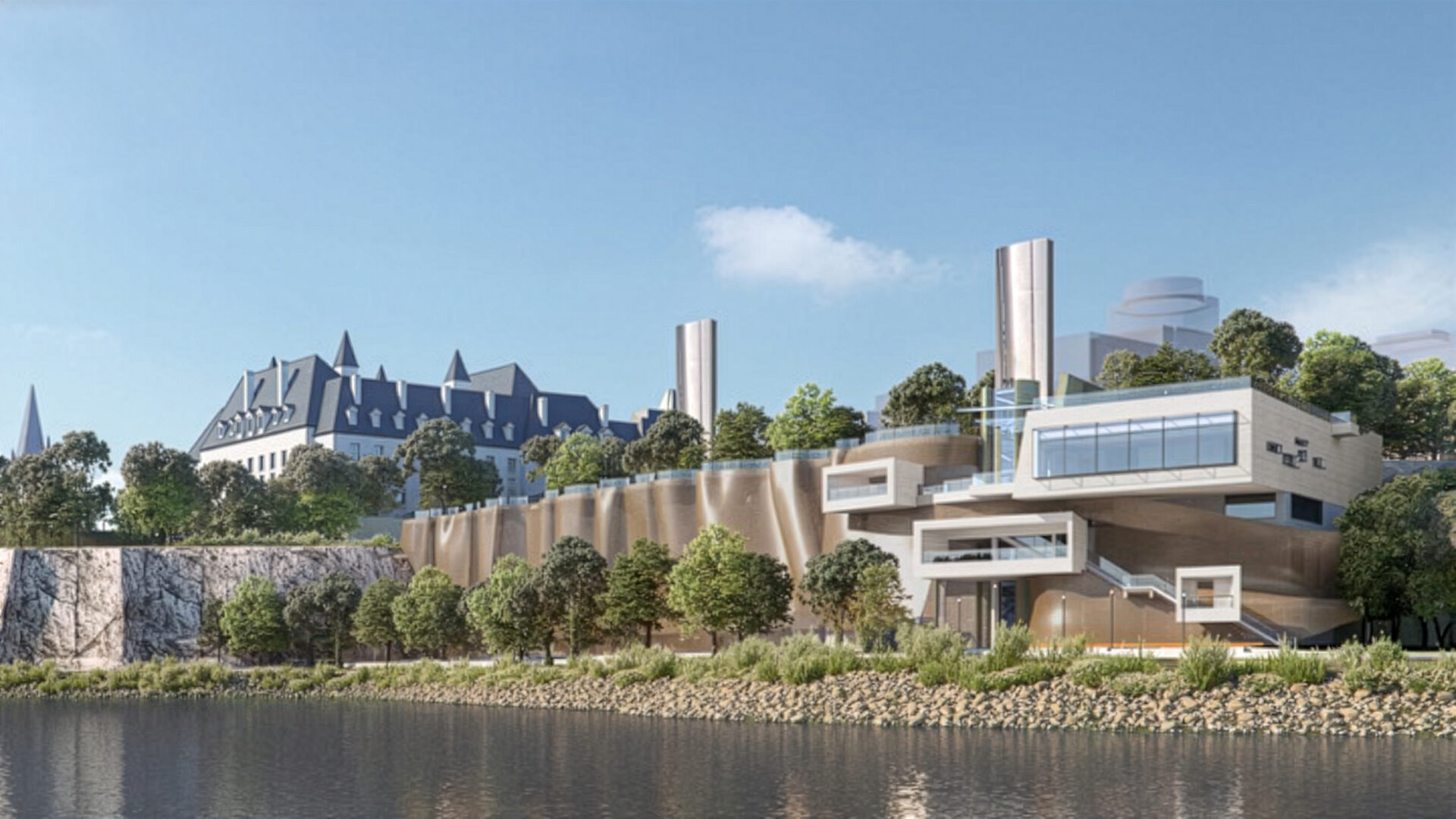
Alongside the conference, federal officials will mark a defining milestone for Canadian infrastructure: the ribbon-cutting for the Cliff Energy Centre, the centrepiece of a landmark modernization of the federal government’s Energy Services Acquisition Program (ESAP). It is one of the most significant public-private investments in thermal energy infrastructure ever undertaken in Canada, and it has attracted attention from major district energy markets around the world.
The ESAP project is No. 29 on ReNew Canada’s 2026 Top100 Projects report.
The Overlooked Energy Conversation
Much of the energy conversation in Canada focuses on electricity, including megawatts, grid capacity, and transmission corridors. Yet the harder, and often overlooked, challenge is thermal energy for heating and cooling buildings. Heating alone accounts for roughly half of Canada’s total energy demand. It is the single largest driver of household energy costs. For decades, however, thermal energy has sat largely outside national energy policy.
This is starting to change, and the proof is in the pipe.
How It Works and Why Scale Matters
District energy is not a new concept. Canadian institutions and municipalities have operated district energy systems for more than a century. The idea is straightforward: instead of each building operating its own boilers or chiller plant, multiple buildings connect to a shared thermal network. Hot water, steam, or chilled water is produced or recovered at a central facility and distributed through insulated underground pipes to office buildings, hospitals, universities, residential towers, and transit facilities, providing heating and cooling to every building connected.
What makes this approach powerful is aggregation. By combining the thermal heating and cooling requirements of many connected buildings, district energy systems can access and leverage resources that may not be feasible at the individual-building scale, like heat recovered from a data centre, cold extracted from a lake or river, steam from a waste-to-energy facility, or geothermal exchange from below the frost line.
These are local, affordable, low-carbon resources that individual buildings simply cannot access on their own.
The result is infrastructure that delivers on climate progress, energy affordability, and resilience all at once and all through the same set of pipes.
Already at Work in 200 Canadian Communities
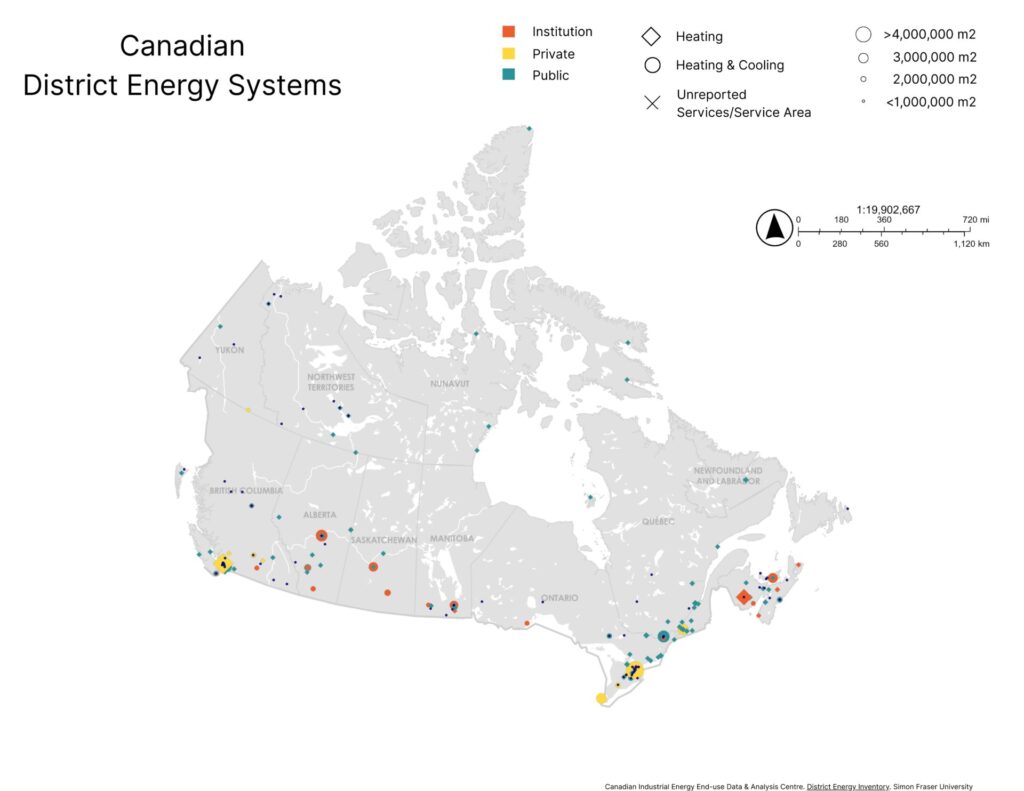
District energy already operates in more than 200 Canadian communities from coast to coast, serving millions of square metres of built space with increasingly clean energy.
Today, these systems meet just 2.5 percent of national heating demand, underscoring an extraordinary growth opportunity for Canada.
In Toronto, Enwave has operated the world’s largest deep-lake water-cooling system for more than two decades, drawing cold water from Lake Ontario to cool downtown office buildings. The system reduces electricity demand during summer peaks and simultaneously cuts carbon emissions.
In Vancouver and Markham, sewage heat recovery systems extract low-grade heat from wastewater, energy that would otherwise be lost, and upgrade it with large-scale heat pumps to serve residential and commercial buildings.
In Prince Edward Island and Vancouver, waste-to-energy facilities capture heat from municipal solid waste, displacing fossil fuels with a resource that would otherwise go to landfill.
Three cities, three different energy sources, and the same underlying logic.
The Federal Government Steps Up
The most significant recent signal of federal commitment is the modernisation of ESAP, a program that provides thermal energy to more than 80 federal buildings across the National Capital Region. A public-private partnership that recovers local waste heat, shifts peak demand, and replaces ageing fossil-fuelled assets with a thermal grid built for the next generation is exactly the kind of long-life, infrastructure-led investment the sector has long called for.
The Cliff Energy Centre, set to be commissioned this summer, is among the most ambitious district energy projects in North America. It offers a practical, replicable blueprint that federal campuses, major institutions, and municipal governments around the world can follow.
Ottawa in June: The World Comes to See What’s Next
IDEA2026 takes place 23-26 June 2026 at Rogers Centre Ottawa. The International Energy Agency’s (IEA) District Heating and Cooling Executive Committee, representing 17 countries, will convene alongside the conference and a memoranda of understanding will be signed. Delegations from Europe, Asia, the Middle East, and North America will participate in workshops, plenary panels, technical tracks, walk the trade show floor, tour Canadian systems, and return home with a clearer picture of what Canada has built and what is possible.
An Opportunity That Cannot Wait
Canada has world-class projects, experienced operators, committed federal and provincial partners, and a growing development pipeline. What it needs next is a policy framework that treats thermal energy with the same seriousness as electricity, and the investment incentives to match.
The urgency is not just environmental. More than half of the natural gas used to heat homes in Ontario, Quebec, and Atlantic Canada is imported from the United States. Every building connected to district energy, coupled with domestic waste heat, wastewater, or renewable thermal resources, reduces exposure to supply risks and price volatility while freeing Canadian natural gas for higher-value export markets.
Every municipality with a hospital, university campus, downtown core, or federal facility complex is a candidate for district energy. Every industrial park or data centre with surplus heat, every lake with cold water, every wastewater system with untapped warmth is a resource waiting to be connected.
This June, the world’s district energy community will be in Ottawa to see what Canada has built, and to hear what comes next.
Rob Thornton is president and CEO of the International District Energy Association (IDEA), a global nonprofit founded in 1909 that advances efficient, resilient, and sustainable district energy systems. He has worked in the district energy industry since 1987 and has served as IDEA’s president and CEO for more than 25 years, representing over 3,000 members across more than 28 countries. Learn more at districtenergy.org. IDEA’s 117th Annual Conference & Trade Show takes place 23-26 June 2026, at Rogers Centre Ottawa.